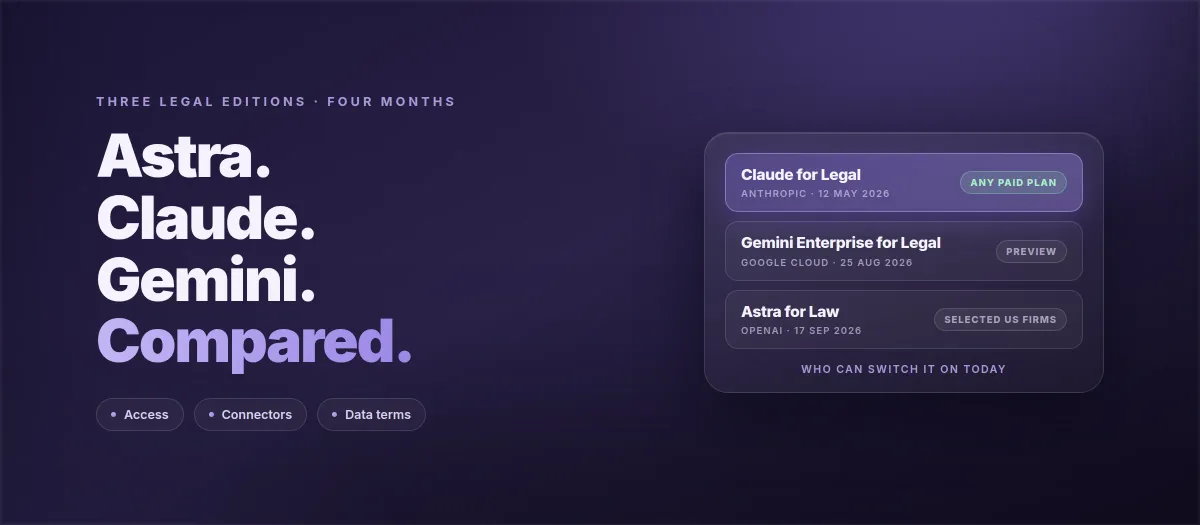
Three AI labs shipped a legal edition inside four months. Anthropic released Claude for Legal on May 12, 2026. Google Cloud announced Gemini Enterprise for Legal on August 25. OpenAI followed with Astra for Law on September 17. For a firm under 50 attorneys, only one of the three can be switched on today without an application or an integrator, and that one is Claude for Legal. The choice that decides your results sits one level down: what connects the model to your matters, and who owns that layer.
We develop software and AI for law firms of 2 to 50 attorneys, and we maintain free open-source connectors that link Claude to Clio and to MyCase. So we have a stake here. Every fact below traces to launch coverage from LawSites, Artificial Lawyer and Legal IT Insider. Treat it as a diagnostic for your situation. We don't name an overall winner.
Anthropic · May 12, 2026
Claude for Legal
Open today
Open to any paid Claude customer. 20+ named connectors and 12 open-source plugins. No research index of its own.
Google Cloud · August 25, 2026
Gemini Enterprise for Legal
Preview
In preview with four large launch firms, and it arrives through integrators. Fits firms already standardised on Google Cloud.
OpenAI · September 17, 2026
Astra for Law
Gated
The strongest research story and the narrowest door: its own index of US law, inside a program for selected US firms.
What none of them covers
None of the three names a connector for MyCase, Smokeball, Filevine or PracticePanther. For a firm under 50 attorneys, that gap decides more than the model does.
How do the three legal editions compare side by side?
Facts checked on September 19, 2026. Swipe the table sideways on a phone.
|
Astra for Law (OpenAI) |
Claude for Legal (Anthropic) |
Gemini Enterprise for Legal (Google Cloud) |
| Launched |
September 17, 2026 |
May 12, 2026 |
August 25, 2026, in preview |
| Who can use it today |
Gated
"Selected law firms in the United States" inside the Trusted Access program, aimed at the Am Law 200 per LawSites. A paid ChatGPT plan doesn't make it appear. API "coming soon". |
Open
Any paid Claude customer. No access gate, free to install. |
Preview
With four large launch firms. Wider availability: not stated at launch. |
| Legal research index |
Its own Legal Search Index: 230M+ URLs of US case law, statutes, regulations and court rules, built with Free Law Project's CourtListener. |
No index of its own announced. Research runs through connectors such as Midpage, Trellis, Descrybe and Free Law Project. |
No index of its own announced. Connectors to research systems. |
| Connectors and plugins at launch |
26 partner plugins plus 9 community plugins and 47 custom skills. No complete list published. Named so far include HighQ, Clio, Relativity, iManage Work, NetDocuments, Harvey and Legora. |
20+ MCP connectors, all named, and 12 plugins. Includes iManage, NetDocuments, Relativity, Harvey and Thomson Reuters CoCounsel Legal. |
Legal skills, pre-built agents, and connectors to document management, e-discovery and research systems. Counts and names: Not stated at launch. |
| Small-firm practice management (Clio, MyCase, Smokeball, Filevine, PracticePanther) |
Clio only, through Vincent, for Vincent and Clio Work customers. None of the other four named. |
None of the five appears in Anthropic's connector list. |
None of the five named. |
| Data terms as announced |
For admitted firms: zero data retention on the API, and ChatGPT Enterprise excluded from human review by anyone at OpenAI. Full agreement runs about 30 pages. |
Follows your Claude plan. Zero data retention applies to API and commercial keys, and does not apply to Team or Enterprise chat. |
Not stated at launch |
| Jurisdictions |
The index covers US law only. No other jurisdiction announced. |
Not stated at launch |
Not stated at launch |
| How it's delivered |
Program. Admitted firms see "GPT-6 Astra Law" in ChatGPT and Codex. |
Self-serve. Install the plugins on a paid plan. |
Integrators: Accenture, Deloitte, KPMG, Factor Law and others. |
| What you keep if you leave |
Not stated at launch |
The plugins. They're open source under Apache 2.0 in a public repository, so your copies stay yours. |
Not stated at launch |
"Not stated at launch" means the launch coverage we checked gave no answer. Put that question to the vendor in writing.
Where does Astra for Law win?
Research. LawSites describes Astra for Law as a configuration of GPT-6 Astra: legal writing instructions, settings for thorough work, and a new Legal Search Index. The other two editions have no index of their own. OpenAI says it covers "more than 99.9% of published U.S. precedential case law".
How accurate is Astra for Law on legal research?
OpenAI published a number. On the private validation set of the Vals AI Legal Research Bench, 200 US legal research questions, Astra for Law scored 54.0% correct against 38.7% for GPT-6 Astra with web search. That gap is where the "40% more accurate" headline comes from, and it's a relative figure.
Correct answers on 200 US legal research questions
GPT-6 Astra with web search38.7%
Source: OpenAI's own figures, Vals AI Legal Research Bench, private validation set. No independent replication yet. Claude for Legal and Gemini Enterprise for Legal published no comparable number.
These are OpenAI's own numbers, with no independent replication we've seen. Read the other half too: 46% of questions still failed, and OpenAI itself says the output needs professional review and citation verification. Its launch post also compares memos against Claude on examples OpenAI chose, so weigh that as vendor material.
The limit for a small firm
Access. Trusted Access admits "selected law firms in the United States", and LawSites reports it's aimed at the Am Law 200. A paid ChatGPT plan doesn't make GPT-6 Astra Law appear. An API is "coming soon", with Harvey named among the companies building on it, and pricing hasn't been disclosed. Launch coverage doesn't say whether a ChatGPT Business workspace outside the program can install the partner plugins. For a 15-attorney firm, it's something to watch.
Where does Claude for Legal win?
Availability and openness. There's no gate. Claude for Legal is free to install for any paid Claude customer, and its 12 plugins (Commercial, Corporate, Employment, Privacy, Litigation, IP and six more) sit in a public GitHub repository under Apache 2.0. Anthropic also named every one of its 20+ MCP connectors on day one, the longest published connector list of the three. Harvey and Thomson Reuters CoCounsel appear in both Anthropic's and OpenAI's lists: the large legal AI vendors are connecting to every lab they can.
The licence matters. You can open a plugin, read exactly what it tells the model to do, and edit it for your practice. Your copy stays yours, so this is the only edition where the "what you keep if you leave" row has an answer. Install path: Claude for Legal for small and mid-size firms.
The limit for a small firm
Two things. Research quality depends on which third-party connectors you add, since there's no index of its own. And the connector list leans toward large-firm systems such as iManage, Relativity and Datasite. Clio, MyCase, Litify and Salesforce are absent. On Claude Enterprise, only Owners and Primary Owners can add connectors, and audit logs exist on Enterprise only, kept for 180 days. Start with which Claude plan a law firm needs.
Where does Gemini Enterprise for Legal win?
With firms already standardised on Google Cloud that have an integrator relationship in place. Google announced it in preview with Cleary Gottlieb, Freshfields, Weil and Williams & Connolly. On offer: legal skills, pre-built agents, and connectors to document management, e-discovery and research systems, delivered through Accenture, Deloitte, KPMG, Factor Law and others. If your firm already buys technology that way, this fits.
The limit for a small firm
Delivery. A 12-attorney firm rarely has a global consultancy on call, and a preview sold through integrators has no self-serve door. Also, Gemini Enterprise for Legal is a separate product from the Gemini bundled with Google Workspace. When we checked on August 26, 2026, Gemini on a Workspace work account couldn't add a custom connector at all.
What does none of the three give a small firm?
A way into the system where your matters live. None of the three legal editions names a connector for MyCase, Smokeball, Filevine or PracticePanther. Clio appears only in OpenAI's list. Per LawSites' roundup of vendor integrations, Clio's plugin brings Vincent's legal research and docket content into Codex over MCP, for Vincent and Clio Work customers.
In practice, the model can reason and it can't see your matters. Ask which matters have had no activity in 30 days, or which deadlines land next week, and there's nothing for it to look at, because those answers live in practice management. So staff copy and paste between two windows, which is where the hours go.
How do firms on Clio or MyCase close that gap today?
On Claude, ready routes exist. We built Clio MCP and MyCase MCP. Both are free, open source under the MIT licence, built for Claude, with audit logging built in. MyCase also ships its own official Claude connector, built by its parent company 8am: read-only, included with paid MyCase plans, and available to firms on Claude Team or Enterprise. Compare them in MyCase and Claude integration solutions and Clio MCP connectors compared.
We haven't run our connectors in ChatGPT or Gemini, so we make no claim about either. Firms on Smokeball, Filevine or PracticePanther get nothing on this front from any of the three.
On Clio or MyCase and want the model to see your matters?
Both connectors are free and open source. Tell us your practice management system and your AI plan, and we'll say what it takes to run it firm-wide.
Which data terms apply to my plan?
Terms follow the plan and the contract, whatever the product is called. Astra for Law's announced terms are zero data retention on the API and ChatGPT Enterprise excluded from human review by anyone at OpenAI. Those apply to firms admitted to Trusted Access and sit inside an agreement of about 30 pages. Jason Boehmig, who leads OpenAI's legal vertical, said it doesn't reduce to a one-sentence summary. A firm on an ordinary ChatGPT plan gets different terms.
On Claude, zero data retention applies to API and commercial keys and to Claude Code for Enterprise. Team and Enterprise chat fall outside it. Enterprise chat retention is configurable with a 30-day minimum. We explain the split in zero data retention on Claude, Team vs API. For Gemini Enterprise for Legal, the coverage we checked stated no terms, so ask for them in writing. Data terms are one input to your ethics analysis, and our privilege tiers post covers the rest.
Who owns the layer between the model and your matters?
Artificial Lawyer called this moment "the battle for centrality". Foundation labs, Harvey and the research publishers all want to be the place lawyers stay. The sharpest line: "in a world where usage-based (i.e. token) pricing is becoming more relevant to some companies, then such companies really, really want you to stay where you are."
Every plugin installed inside one platform, every saved prompt, every habit your paralegals form there raises the cost of leaving. Under token pricing, the platform earns more the longer your work stays put. That's ordinary platform economics, and you can plan for it.
So ask who owns the layer in between. Three pieces make it up: the connector setup (systems, permissions, each attorney signing in as themselves), the audit log of what the AI read and wrote, and the server those two run on. Own all three and you can change the model underneath when pricing, quality or terms shift, without redoing the work. MCP helps: Anthropic's connectors use it, and both Thomson Reuters' HighQ and Clio's Vincent plugin reach OpenAI over it. Any switch still needs testing. We describe that setup on our firm deployment page.
1
The connector setup
Which systems it reaches, what it may read and write, and each attorney signing in as themselves.
2
The audit log
A record of what the AI read and wrote, with a name on every line.
3
The server
Where the first two run. If it's yours, the model underneath can change without redoing the work.
How should a firm under 50 attorneys choose?
Already on Claude Team
Install the Claude for Legal plugins that match your practice areas. If you're on MyCase and only need Claude to read, use MyCase's official connector first: it's the vendor's own tool and it's included in your plan.
Already on ChatGPT Business
Keep using it for drafting and summarising. Astra for Law won't appear on your plan, so watch for the API. Don't switch vendors for a product you can't buy.
On Google Workspace
The bundled Gemini is a different product from the legal edition. If you hold a Google Cloud contract and work with an integrator, ask about the preview. Otherwise there's nothing to switch on yet.
Heavy US case-law research
Astra for Law's index is the one new research asset among the three, and you probably can't get it yet. Keep your current research subscription, and verify every citation whichever tool produced it.
You want AI to read and write your matters
None of the three legal editions does this, so the connector is the decision. On Clio, look at Clio MCP. On MyCase, compare the official connector with ours. Clio Work customers should ask Clio what Vincent covers first.
Notice how often the answer is "use the vendor's own tool". When the company holding your data ships a connector that covers your need, that's the simplest thing to support.
Frequently Asked Questions
Is Astra for Law better than Claude for Legal?
It depends on the job. Astra for Law is the only one of the three with its own legal search index, and OpenAI reports 54.0% correct on a 200-question US legal research benchmark against 38.7% for GPT-6 Astra with web search. Those are OpenAI's own numbers, and 46% of questions still failed. Claude for Legal has no index of its own, yet any paid Claude customer can install it today. For a firm under 50 attorneys the practical difference is access: most can't get Astra for Law.
Can a small law firm use Astra for Law?
Almost certainly not yet. OpenAI released it through a Trusted Access program for selected law firms in the United States, and LawSites reports the program is aimed at Am Law 200 firms. A paid ChatGPT plan doesn't make GPT-6 Astra Law appear. OpenAI says an API is coming soon, so small firms may later reach it through a product built on top. Pricing hasn't been disclosed.
Does Claude for Legal connect to Clio or MyCase?
No. Anthropic's connector list names 20+ systems, including iManage, NetDocuments, Relativity, Harvey and Thomson Reuters CoCounsel Legal, and it doesn't include Clio or MyCase. Firms connect those separately. Oktopeak maintains free open-source MCP connectors for Clio and for MyCase, and MyCase also ships its own official read-only Claude connector for firms on Claude Team or Enterprise.
Which legal AI platform has the best data protection?
It depends on the plan you're on, and no single platform wins. Astra for Law's announced terms, zero data retention on the API and ChatGPT Enterprise excluded from human review by OpenAI staff, apply to firms admitted to Trusted Access and sit inside an agreement of about 30 pages. On Claude, zero data retention applies to API and commercial keys and doesn't apply to Team or Enterprise chat. Launch coverage for Gemini Enterprise for Legal stated no data terms. Get the terms for your exact plan in writing before client material goes in.
Can a firm switch between them later?
Yes, and the cost depends on where your setup lives. Plugins, saved prompts and habits formed inside one platform stay there. Claude for Legal's plugins are open source under Apache 2.0, so a firm keeps its copies. The other two didn't state at launch what a firm keeps. A firm that owns its connector setup, its audit log and the server they run on can change the model underneath with far less rework, since MCP is an open protocol used by Anthropic's connectors and by several of OpenAI's launch plugins. Every move still needs testing.
Next step
If you want a second opinion on which of these fits the systems your firm already runs, book 30 minutes with us. Tell us your practice management system and your current AI plan, and we'll say plainly what you can switch on this month.