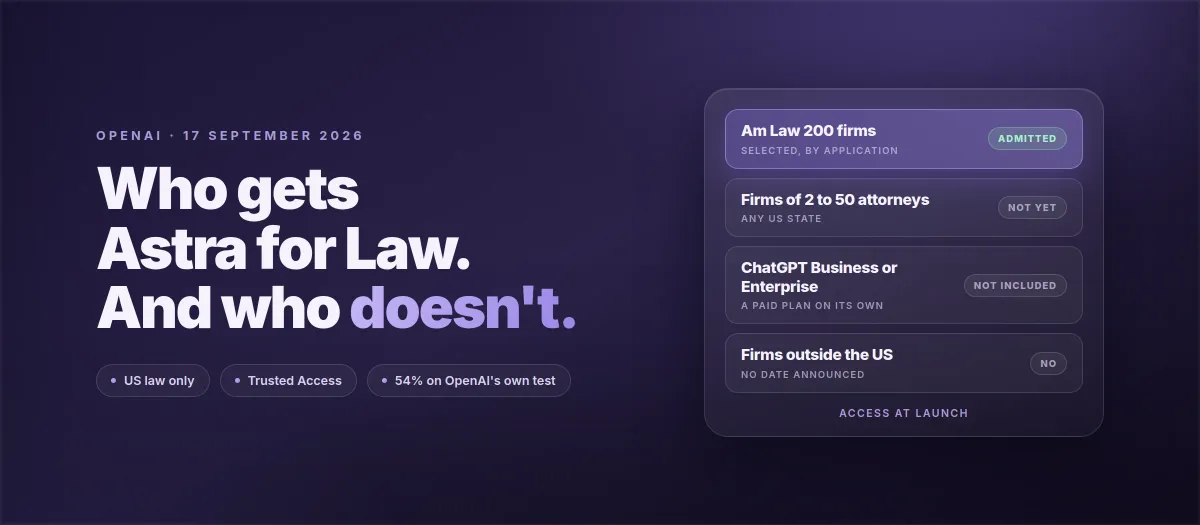
OpenAI announced Astra for Law on September 17, 2026. It's GPT-6 Astra configured for legal work and paired with a new search index of US law, and it's open to selected US law firms through a program called Trusted Access, which is aimed at the Am Law 200.
If your firm has 2 to 50 attorneys, you can't buy it today. A paid ChatGPT plan doesn't make it appear.
Sep 172026. Announced by OpenAI as a legal configuration of GPT-6 Astra.
230M+URLs in the new Legal Search Index. US law only.
54.0%correct on OpenAI's own 200-question research test. 46% still failed.
Am Law 200is who the Trusted Access program is aimed at. A paid ChatGPT plan doesn't unlock it.
What is Astra for Law, exactly?
Astra for Law is GPT-6 Astra with a legal setup on top. LawSites calls it a model configuration, and Artificial Lawyer and Legal IT Insider describe it the same way. The base model went generally available on September 4, 2026. Admitted users see the legal version as "GPT-6 Astra Law" in ChatGPT and Codex.
Three parts make up the configuration, per OpenAI's announcement:
1
Legal instructions
Instructions for legal analysis and legal writing.
2
Thorough-work settings
Settings tuned for thorough work.
3
Legal Search Index
A new index the model searches while it answers. This is the new part.
What is the Legal Search Index?
This index is the new part. Inside it are more than 230 million URLs of US case law, statutes, regulations, court rules and administrative decisions, with sources added daily. OpenAI built it with the Free Law Project and its CourtListener database, and says it covers "more than 99.9% of published U.S. precedential case law."
Does Astra for Law cover law outside the United States?
No. Every category in the index is US law, and OpenAI has announced no coverage of any other jurisdiction. A firm with cross-border matters gets nothing new for that work from this launch.
Who can get Astra for Law?
| If your firm is | Access at launch | Why |
|---|
| An Am Law 200 firm in the US | By application | Trusted Access is offered to selected US law firms, and LawSites reports it's aimed at this group. |
| A US firm of 2 to 50 attorneys | Not yet | Outside the program. OpenAI says an API is coming, so it may reach you inside vendor products later. |
| On ChatGPT Business or Enterprise | Not included | A paid plan doesn't make GPT-6 Astra Law appear. Admission to the program does. |
| Outside the United States | Not announced | Selected US firms only, and the index holds US law only. |
What is the Trusted Access program?
Trusted Access is OpenAI's gate for this product. It's offered to "selected law firms in the United States," for eligible lawyers and people working under their supervision. LawSites reports the program is targeted at Am Law 200 firms. Holding a paid ChatGPT plan doesn't make GPT-6 Astra Law appear. Admission does.
Two terms for admitted firms have been reported: zero data retention on the API, and ChatGPT Enterprise usage excluded from human review by anyone at OpenAI. The full agreement runs about 30 pages. Jason Boehmig, who leads OpenAI's legal work, said it doesn't reduce to a one-sentence summary. Those two terms describe retention and review. Whether any AI arrangement satisfies your professional duties is a call for your own ethics analysis.
Which firms have it?
Four launch firms were named: Latham & Watkins (governance, ethical walls, client instructions), Sullivan & Cromwell (an agreement analyzer with negotiating playbooks), Ropes & Gray (M&A diligence traced to source documents) and Cooley (IPO preparation, under the name GO Public). Every one is a Big Law name, which tells you who the program was designed around.
What does it cost, and is there an API?
OpenAI hasn't disclosed pricing. The API is listed as "coming soon," with Harvey and Legora named as companies that will build on it. For a firm outside the program, vendor products look like the likeliest route later, on a timeline nobody has published.
How accurate is Astra for Law?
On the Vals AI Legal Research Bench, using a private validation set of 200 US legal research questions, Astra for Law was correct 54.0% of the time. GPT-6 Astra with ordinary web search scored 38.7%. The "40% more accurate" headline is the relative gap between those two figures.
Correct answers on 200 US legal research questions
GPT-6 Astra with web search38.7%
Source: OpenAI's own figures on the Vals AI Legal Research Bench, private validation set. The bars run to 100%, so the empty part of the top bar is the 46% of questions that still failed.
These are OpenAI's own numbers. Read the other side of 54.0% too: 46% of questions still failed the overall check. OpenAI itself tells users the output needs professional review and citation verification.
Why does a 54% score matter for a firm that files things?
Because courts have already put a price on the failure mode. Damien Charlotin's public AI Hallucination Cases database listed 2,045 court decisions involving fabricated AI content when we checked on September 19, 2026, 1,397 of them in the United States. A model that's right on roughly half of hard research questions is a fast first pass for a lawyer who checks every cite.
Somebody at your firm still has to pull every case.
What did the HAQQ test find?
HAQQ ran 41 prompts across 20 practice areas on September 10, 2026. On six questions covering Saudi Arabia, the UAE, France, Qatar and Egypt, the model cited the correct provision every time and was legally correct 66.7% of the time. HAQQ's phrase for that gap is a failure "no citation checker catches": the cite is real, and the legal conclusion drawn from it is wrong.
Two caveats. HAQQ sells legal AI, so this is a vendor's test, and six questions is a small sample. Also, HAQQ tested base GPT-6 Astra a week before Astra for Law was announced, so it says nothing direct about the legal configuration. What it shows is a kind of error a US-only index won't fix.
What came with the launch?
Plugins. OpenAI announced 26 partner-built plugins and 9 community plugins and 47 custom skills, the community ones from LegalQuants, LegalEng Consulting Group and Skills.law. OpenAI didn't publish a complete list when LawSites asked for one.
Named so far, and the small-firm systems that weren't
- iManage
- NetDocuments
- Relativity
- Everlaw
- Box
- HighQ
- Ironclad
- DocuSign
- Harvey
- Legora
- Clio, through Vincent
- MyCase
- Smokeball
- Filevine
- PracticePanther
- Litify
Read that list as a small firm. It's document management, e-discovery, contract tools and Big Law platforms. Only one small-firm practice management system is on it, Clio, and Clio arrives through Vincent: the plugin brings Vincent's legal research and docket content into Codex over MCP, for Vincent and Clio Work customers. MyCase, Smokeball, Filevine, PracticePanther and Litify appear on none of the lists published so far.
No source we've read says whether ChatGPT workspaces outside Trusted Access can install these plugins. We keep a running list of the ChatGPT legal plugins.
What can a firm outside the Am Law 200 run today?
Quite a lot. What makes AI useful in a 12-attorney firm is mostly the setup around the model, and none of that setup sits behind OpenAI's gate.
1
Which model can we use, and on what data terms?
Any frontier model your firm can buy directly, on a plan whose data terms you've read. Those terms differ by plan, sometimes sharply. Zero data retention exists only on specific arrangements, and a consumer chat subscription isn't one of them. The defensible ceiling is training disabled plus zero data retention, where the plan actually provides it. We've written up which Claude plan a law firm needs and where zero data retention is and isn't available.
2
How does the model reach our matters?
Through a connector into your practice management system. A model that can't see your matters, contacts, tasks and calendar is a research toy. We publish two connectors, free and open source: one for Clio and one for MyCase. Both use MCP, an open protocol that ChatGPT also supports in developer mode.
MyCase also ships its own official read-only Claude connector for Claude Team and Enterprise. If your firm holds one of those plans and only needs Claude to read MyCase data, it's a sensible choice.
3
What does it take to run this across the whole firm?
A connector installed on one attorney's laptop works for one attorney. Firm-wide use needs the deployment half: each attorney signs in as themselves, every call lands in one audit log with a name on it, and the connector runs on a server the firm owns instead of a desktop that has to be switched on. Once it's a server address, scheduled work becomes possible too, such as a morning sweep of deadlines. That's what our firm deployment service sets up. Your firm owns the connector setup, the audit log and the server it runs on, whichever model you point at it next year.
Is there a big-lab legal edition with no access gate?
Yes. Anthropic released Claude for Legal on May 12, 2026, with more than 20 connectors and 12 practice-area plugins. It's free to install for any paid Claude customer, there's no access program, and the plugins are open source under Apache 2.0. Its connector list has no Clio or MyCase entry, which is the gap the connectors above fill. Our guide to Claude for Legal for small firms covers what shipped.
Want parts 2 and 3 running in your firm?
The Clio and MyCase connectors are free and open source. The firm-wide setup around them, with per-attorney sign-in and one audit log on a server you own, is what we do.
How does Astra for Law compare with Claude for Legal and Gemini Enterprise for Legal?
Three big labs now have a legal edition. Four rows cover what a small firm needs to know.
| |
Astra for Law (OpenAI) |
Claude for Legal (Anthropic) |
Gemini Enterprise for Legal (Google Cloud) |
| Who can buy it today |
Gated
Selected US firms admitted to Trusted Access, aimed at the Am Law 200 |
Open
Any paid Claude customer. Free to install, no gate |
Preview
Delivered through integrators such as Accenture, Deloitte and KPMG |
| Legal research index |
Its own Legal Search Index: 230M+ URLs, US law only |
Research through connectors (Free Law Project, Midpage, Trellis, Descrybe, Thomson Reuters CoCounsel Legal) |
Connectors to research systems |
| Small-firm practice management coverage |
Clio only, through Vincent |
No Clio, MyCase or Litify connector on Anthropic's list. Open-source connectors cover Clio and MyCase, plus MyCase's official read-only one |
Launch connectors cover document management, e-discovery and research systems |
| Launch date |
September 17, 2026 |
May 12, 2026 |
August 25, 2026 (preview) |
The full version is in Astra for Law vs Claude for Legal vs Gemini Enterprise for Legal.
Should we wait for Astra for Law?
That depends on what you want AI for.
Research is the only need, and you already pay for Westlaw or Lexis
Wait. It costs you nothing. Let the Am Law 200 find the rough spots.
You want AI working inside your matters
Don't wait. Drafting the status update from the file, finding every matter with a deadline this week, logging the call that just ended: for that job the gate is irrelevant. All of it happens in the connector and deployment layer, which is open to you today with whichever model you choose.
You're an Am Law 200 firm with heavy US case-law research, already on ChatGPT Enterprise
Apply. You have the procurement team to read a 30-page agreement and the research volume to feel a jump from 38.7% to 54.0%. Your lawyers are already in ChatGPT all day, so nothing has to be switched.
Frequently Asked Questions
Can a small law firm get Astra for Law?
Not today. OpenAI offers Astra for Law to selected law firms in the United States through its Trusted Access program, and LawSites reports the program is aimed at Am Law 200 firms. A paid ChatGPT plan doesn't make GPT-6 Astra Law appear. OpenAI says an API is coming soon and names Harvey and Legora as builders, so smaller firms may eventually meet it inside vendor products.
Is Astra for Law a new model?
No. Astra for Law is a configuration of GPT-6 Astra, the model OpenAI made generally available on September 4, 2026. It appears as GPT-6 Astra Law in ChatGPT and Codex and adds three things: instructions for legal analysis and writing, settings for thorough work, and a Legal Search Index of more than 230 million URLs covering US case law, statutes, regulations, court rules and administrative decisions.
How accurate is Astra for Law?
On OpenAI's own numbers, Astra for Law answered 54.0% of 200 US legal research questions correctly on a private validation set of the Vals AI Legal Research Bench, against 38.7% for GPT-6 Astra with web search. The 40% improvement in the headlines is the relative gap between those two figures. 46% of questions still failed the overall check, and OpenAI itself says the output needs professional review and citation verification.
Does Astra for Law cover law outside the United States?
No. The Legal Search Index covers US case law, statutes, regulations, court rules and administrative decisions, and OpenAI has announced no coverage of any other jurisdiction. One early vendor test by HAQQ, run on base GPT-6 Astra a week before Astra for Law was announced, found it legally correct 66.7% of the time across six questions on Saudi, UAE, French, Qatari and Egyptian law. HAQQ sells legal AI and six questions is a small sample.
Does a ChatGPT Business or Enterprise plan include Astra for Law?
No. A paid ChatGPT plan, Business and Enterprise included, doesn't make GPT-6 Astra Law appear by itself. Access comes from admission to OpenAI's Trusted Access program for selected US law firms. For admitted firms the reported terms include zero data retention on the API and ChatGPT Enterprise usage excluded from human review at OpenAI, inside an agreement that runs about 30 pages. Pricing hasn't been disclosed.
Next step
If your firm runs on Clio or MyCase and you want AI working inside your matters with per-attorney sign-in and one audit log, book 30 minutes with us. Bring your current setup and we'll tell you what it would take.