[ OPEN-SOURCE · MIT · ABA 512 ]
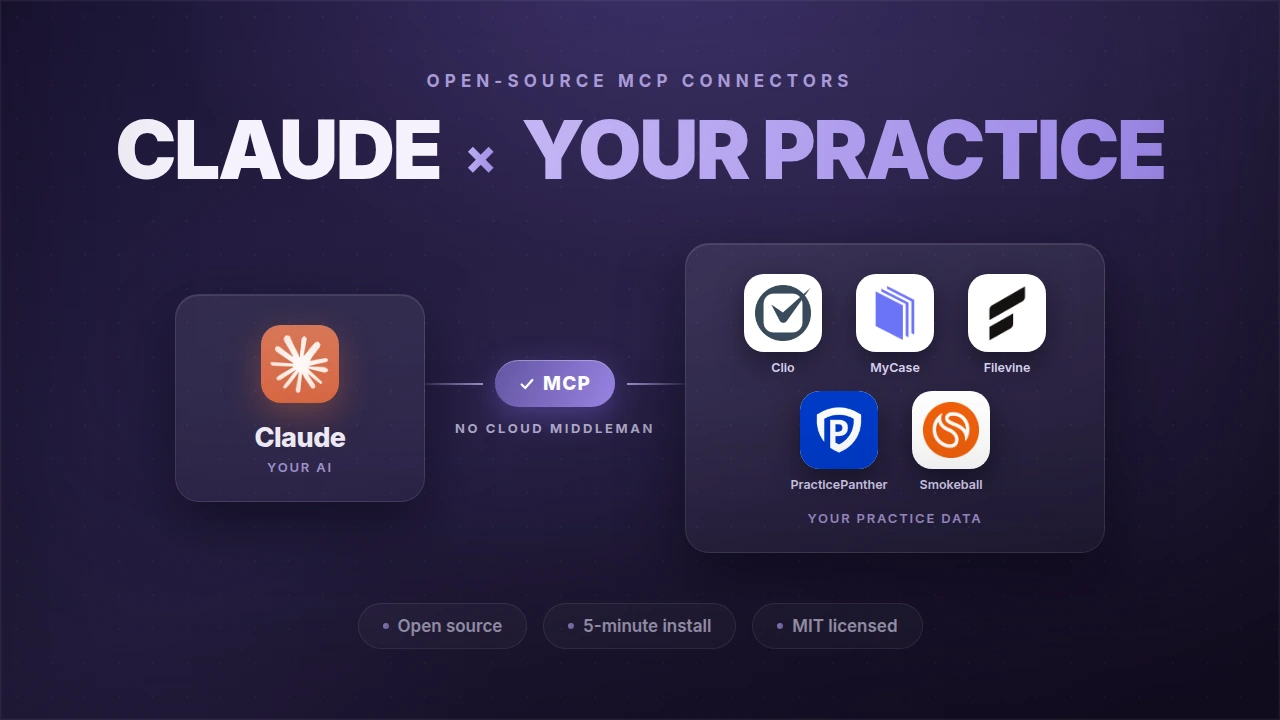
The first open-source Clio MCP server with ABA Opinion 512 audit logging built in. Connect Claude AI directly to your Clio practice management in five minutes. MIT licensed. On npm and the official Anthropic MCP Registry.
34 tools
matters, contacts, docs, tasks, calendar, billing
ABA 512
append-only audit logging
5 min
install with your Clio credentials
[ REAL FIRMS, REAL RECEIPTS ]
★★★★★
“Everything was done professionally, with efficient and fast communication, unconditional availability, kindness and professionalism.”
Verified review · Clutch, 5.0
“It’s very commendable, significant time went into that. Thank you both for open-sourcing it.”
On our Clio connector · June 2026
FROM OUR INBOX · JULY 2026
Running on live dockets
A solo attorney found the connector on npm, installed it himself, ran Claude against his active matters, and emailed us a technically precise bug report the same week. The fix shipped. That is what real usage looks like.
[ TWO WAYS TO RUN IT ]
Free under the MIT license, on npm and the official Anthropic MCP Registry. You need someone comfortable in a terminal, a Clio API application, and about five minutes. Nobody at Oktopeak touches your data or your credentials.
View on GitHubThe same connector as one service in your firm's own cloud: every attorney signs in with their own Clio login, one audit log, one automation built for you each month, a Monday report from week one. No setup fee, no per-seat fee, cancel any time and keep everything.
See the Firm Plan[ THE FIRM-WIDE VERSION ]
Twenty-six seconds: what the connector does for the whole firm, where it runs, what we build each month, and what you keep. Sound on if you like; it works without.
[ LIVE DEMO ]
Two short clips. The first shows Claude reading live case data, creating matters, booking calendar events, and closing tasks. The second is the install walkthrough.
Workflow demo
Claude creates matters, books calendar events, and closes tasks in Clio. Read + scoped write. Every tool call audit-logged.
Install walkthrough
From npm install to authenticated Claude session with live Clio data. Roughly five minutes.
Want this running for your whole firm?
Set up in your own cloud, every attorney with their own login, one automation built each month. $300 a month flat, nothing until it is live.
[ QUICK INSTALL ]
1. Install from npm
npm install -g @oktopeak/clio-mcp2. Add to your Claude Desktop or Claude Code MCP config
{
  "mcpServers": {
    "clio": {
      "command": "npx",
      "args": ["-y", "@oktopeak/clio-mcp"],
      "env": {
        "TRANSPORT": "stdio",
        "CLIO_CLIENT_ID": "your-clio-client-id",
        "CLIO_CLIENT_SECRET": "your-clio-client-secret"
      }
    }
  }
}
3. Inside Claude, run the authenticate tool
Claude calls the local OAuth flow, you confirm in your browser, the token gets encrypted at rest in your OS keychain, and the connector is ready. From this point Claude can read your Clio matters, contacts, documents, tasks, calendar, and billing data on demand.
[ WHAT MAKES OURS DIFFERENT ]
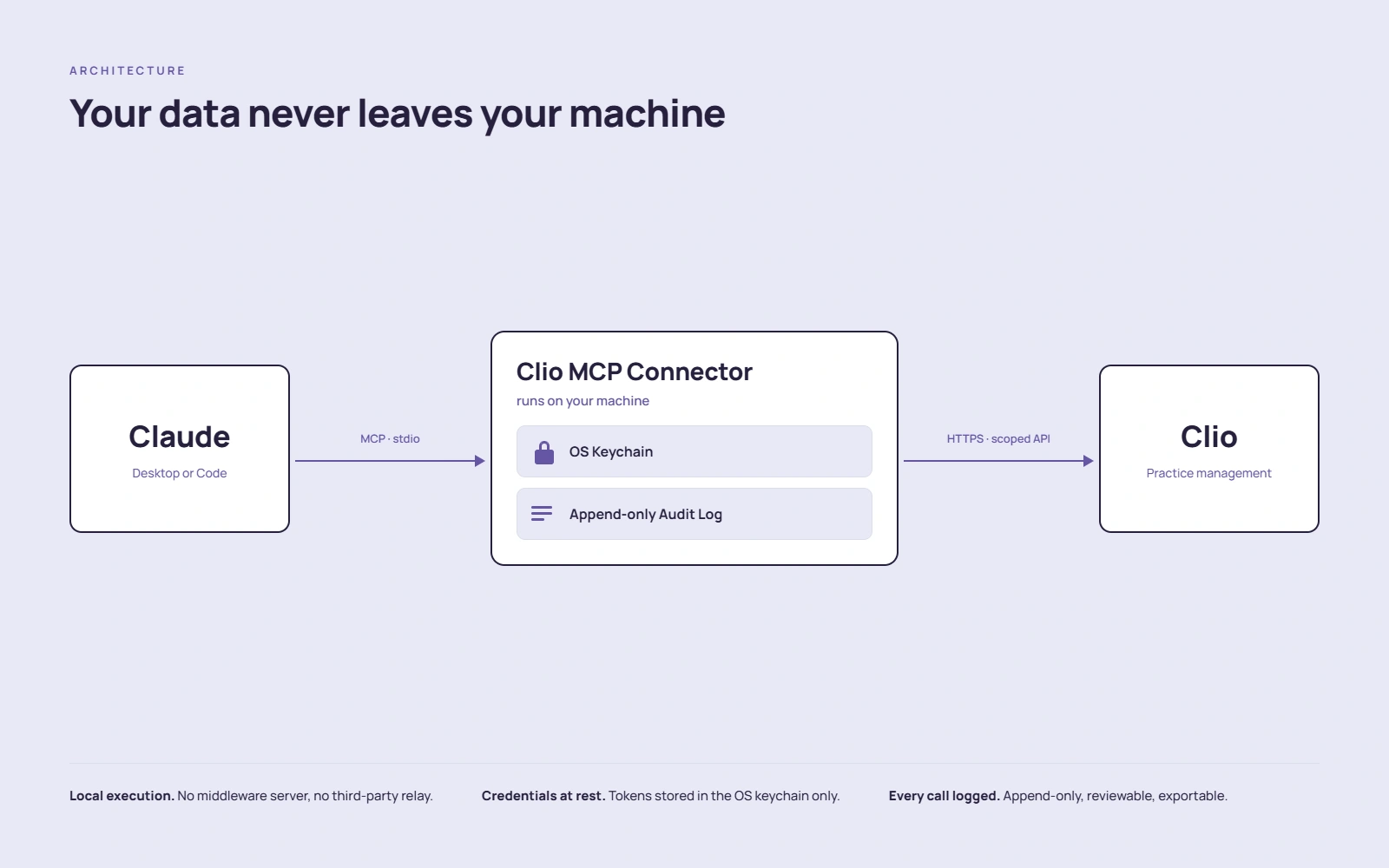
Every Claude tool call is logged append-only with timestamp, tool name, arguments, and result. Mapped to ABA Formal Opinion 512 obligations out of the box. Not a checkbox, a real log a state bar would accept.
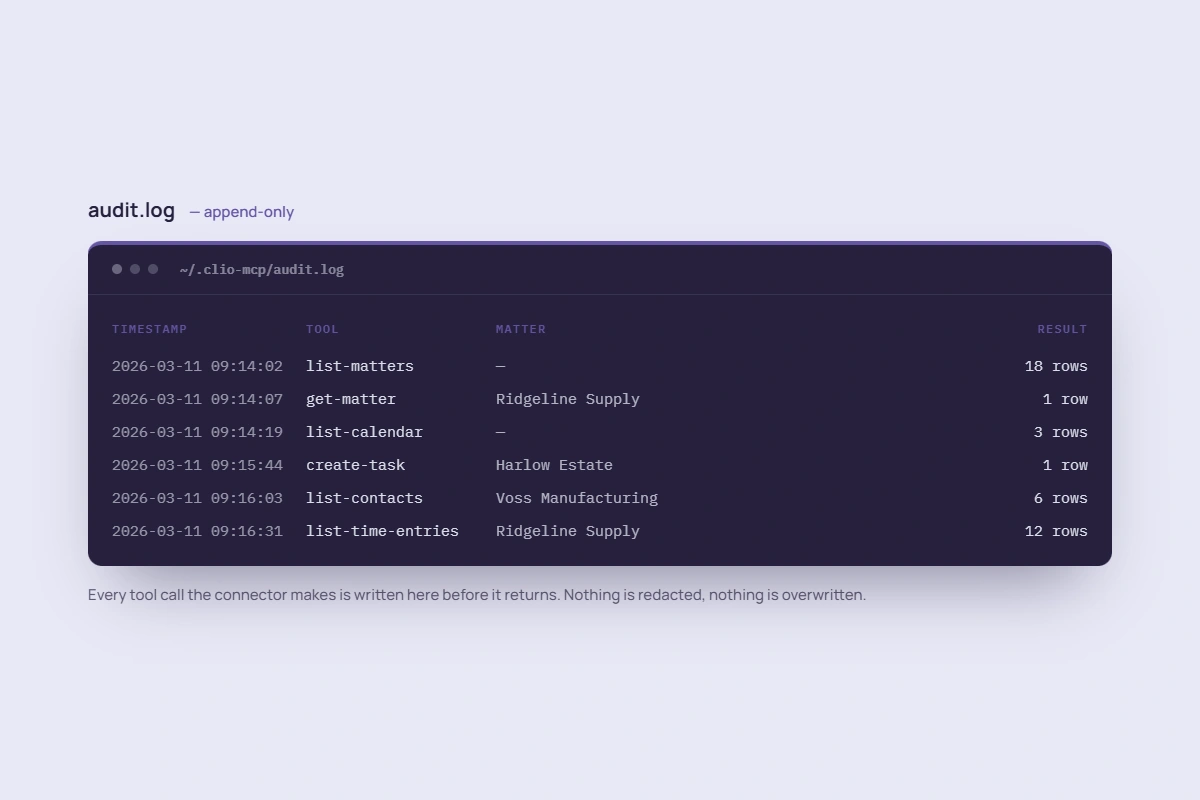
OAuth tokens encrypted with AES-256-GCM and stored in macOS Keychain, Linux secret-service, or Windows Credential Manager. Never plaintext. Never on our servers.
Single-user stdio for Claude Desktop and Claude Code. Multi-session HTTP/SSE for shared deployment and for Claude Cowork or claude.ai custom connectors, which only accept remote MCP servers. Same tool surface either way. Scheduling a skill is the same story: what a scheduled task can and cannot see.
Clio is one of five systems we've built this for, same architecture for MyCase, Filevine, IntakeQ, and Lawmatics. See the whole set in the MCP Connectors case study.
[ OTHER CLIO MCP OPTIONS ]
If you're evaluating options, we wrote a frank feature-by-feature comparison covering LegalContext, lawquarter, LegalMCP, and ours. Yes, we placed ours first, and we explain where each alternative wins.
Read the full comparisonWeighing the connector route against Clio's built-in AI instead? Clio Work vs Claude covers what each does and where each falls short.
Planning a batch job or a nightly sweep? Read what Clio's 50 requests per minute do to a batch run before you write it, and the setup guide if you have not installed the connector yet. On Windows, start with the four things that broke on a real install.
Two questions firms ask in the first week: can Claude see a colleague's calendar, and who in the firm is actually using the connector.
[ PRIVILEGE-SAFE DEPLOYMENT ]
For firms with maximum confidentiality requirements, the same Clio MCP server pairs with LM Studio or Continue.dev running a local model on your hardware. No data leaves your firm. Full guide is the Privilege Stack post.
Read the Privilege Stack guide[ FAQ ]
@oktopeak/clio-mcp, listed on the official Anthropic MCP Registry as io.github.oktopeak/clio-mcp. MIT licensed.npm install -g @oktopeak/clio-mcp, add the server entry to your Claude Desktop or Claude Code MCP config with your Clio API credentials, then call the authenticate tool inside Claude to complete the local OAuth handshake. Full guide on GitHub.claude_desktop_config.json is a process on that laptop, so the task has no way to reach it. To schedule a skill that reads Clio, the connector has to be a remote MCP server over HTTP with a required key and TLS in front, or you move the date checks into a plain cron job and call Claude only for the write-up. We compare the five ways to run a Claude skill on a schedule in what "schedule my Claude skill" actually requires.[ GET STARTED ]
Two paths: install the OSS yourself (free, MIT, on GitHub), or have us deploy it in your firm with scoped credentials, audit log destination, and a workflow designed with your team.
Takes about a minute, and you get the credential request your firm needs either way. Or book a 30-minute call instead.
We asked 32 legal professionals what actually eats their day. The findings are free.