Short answer, which Clio MCP connector?
- Document search only, under 100 documents: LegalContext.
- Australian firm wanting matters, tasks, and notes: lawquarter.
- US litigation with CourtListener and PACER: LegalMCP.
- Full Clio coverage with ABA 512 audit logging built in: Oktopeak's connector, free, on npm; the 5-minute install lives on our Clio MCP server page. Want it deployed in your firm instead of doing it yourself? We set it up for you.
- Also on MyCase, Filevine, IntakeQ, or Lawmatics: same architecture, covered in the MCP Connectors case study. The newest of the set is the Lawmatics MCP server, the first for that CRM on the official Registry.
Why your choice of Clio MCP server matters
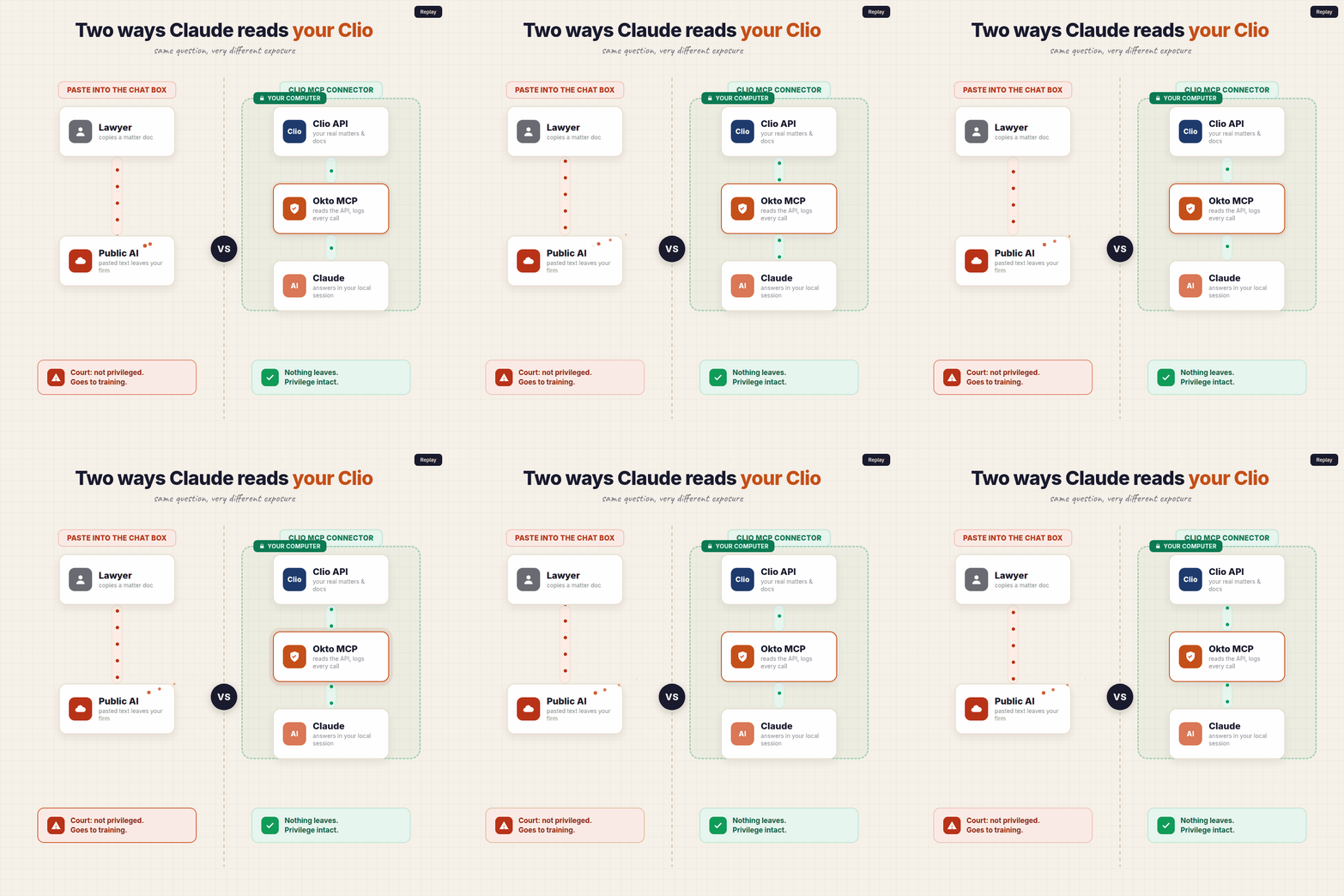
Claude without MCP means copy-paste. A lawyer pastes a matter document into the chat window, gets a summary, moves on. In United States v. Heppner (February 2026), Judge Rakoff of the Southern District of New York ruled that a defendant's exchanges with Claude's consumer tool were not protected by attorney-client privilege, partly because Anthropic's consumer privacy policy permits training on user inputs. Firms that built workflows around paste-into-Claude are now sitting on an exposure problem they didn't know they had.
Claude with MCP changes the shape. An MCP server reads data directly from Clio's API and hands results to Claude in your local session. The matter content is still sent to Anthropic for the model to process, but under commercial terms (the API or Claude Enterprise) it is never used for training, and on a Zero Data Retention organization nothing is stored after the response. That is the opposite of pasting into a consumer chat window, where the content can be retained and used to train. The difference is architectural, not cosmetic, but it depends on running enterprise-tier AI with ZDR, not a personal Pro or Max subscription.
Whichever you pick, run one check the comparison table cannot make for you: open its audit log and see what it stores. They differ more than their feature lists do.
Four open-source connectors currently exist. Each solves part of the problem. None are identical. If you install the wrong one, you either miss capabilities you needed or carry risk you thought you avoided.
Side-by-side feature comparison
Data verified against each repository's README as of April 24, 2026. Oktopeak figures reflect the current v2.0.0 release.
| Feature | LegalContext | lawquarter | LegalMCP | Oktopeak |
|---|---|---|---|---|
| Tool count | 5 | ~6 | 18 | 26 |
| Matters | ✗ | ✓ | ✓ | ✓ |
| Contacts | ✗ | ✗ | ✓ | ✓ |
| Documents | ✓ | ✗ | ✓ | ✓ |
| Tasks | ✗ | ✓ | ✓ | ✓ |
| Calendar | ✗ | ✗ | ✓ | ✓ |
| Billing (read) | ✗ | ✗ | partial | ✓ |
| Notes / Activities | ✗ | ✓ | ✗ | ✓ |
| ABA 512 audit logging | ✗ | ✗ | ✗ | ✓ |
| Encrypted tokens at rest | ✗ | env-var only | ✗ | ✓ |
| License | MPL-2.0 | not listed | MIT | MIT |
| Language | TypeScript | n/a | Python | TypeScript |
| GitHub stars (Apr 2026) | 24 | n/a | 41 | live on npm |
| Jurisdiction focus | Global | Australia | US (with CourtListener/PACER) | Global |
| Bundles non-Clio sources | n/a | n/a | CourtListener + PACER | n/a |
Our recommendation, in one line
If you're a law firm handling privileged client data, start with Oktopeak's Clio MCP connector. It has the most complete Clio coverage of the five (34 tools across all 10 resource areas) and is the only one with ABA 512 audit logging and encrypted tokens built in: the two things that matter most once Claude touches client data. The other three each win a narrow case (document-search-only, Australia-specific, or bundled US case-law research), and we cover each honestly below so you can verify the claim yourself. Want it deployed in your firm instead of doing it yourself?
See it free on your matter in 48h →1. LegalContext (protomated/legal-context-ce)
github.com/protomated/legal-context-ce: TypeScript, MPL-2.0, 24 stars as of April 2026.
What it does. Semantic document search over your Clio document library. Uses LanceDB to build a local vector index of documents and enables Claude to search them via natural language queries. Core tools: auth:simple (OAuth flow), index:batch (index documents), check:clio (verify connection), test:extraction, reset-index-tracking.
Clio scope. Documents and folders only. OAuth scopes requested are limited to documents and folders. The README explicitly does not support matters, contacts, tasks, calendar, billing, or any other Clio resource.
Compliance. Emphasizes local processing and no cloud dependencies. Tracks queries via a local counter (for enforcing the free tier's 50-query-per-day limit) but does not implement formal append-only audit logging aligned with ABA Opinion 512 requirements.
Known limitations. The free tier caps at 100 indexed documents and 50 queries per day. Designed as a single-user tool, not a firm-wide deployment. If your firm has more than 100 documents (essentially every firm), you either pay for the commercial tier or you hit the ceiling.
Who it fits. A solo attorney or very small firm wanting Claude to find documents inside Clio's document storage. If document search is 100% of what you want from Claude + Clio, this works within its cap. Searching a far larger corpus is a different build entirely: see our breakdown of AI legal document search for what 100ms retrieval across 1M+ documents actually takes.
2. lawquarter/MCP_Server_Clio
Listed on Glama, Awesome MCP Servers, and mcpservers.org. Still maintained as of March 2026 per directory listings. Limited public README; details drawn from directory metadata.
What it does. Enables Australian legal professionals to access matters, tasks, notes, and activities through natural language via Claude. Roughly six tools spanning those four resource types.
Clio scope. Matters, tasks, notes, activities. Does not cover documents, contacts, calendar, or billing. Uses environment variables for Clio OAuth credentials and an encryption key configured in a .env file, so tokens can be encrypted, but the encryption is user-managed rather than baked in.
Compliance. The listing notes the project "is not endorsed or sponsored by Clio" and that users bear responsibility for jurisdictional data protection compliance. No explicit ABA Opinion 512 alignment. No published audit-logging mechanism.
Known limitations. Built specifically for the Australian Clio endpoint. US, EU, and Canada firms will need to reconfigure or fork to point at their regional API. No support for document access or billing. License not clearly published on directory listings.
Who it fits. An Australian firm that wants Claude to manage matter-level activity (tasks, notes, activity logs) without touching documents or billing. Jurisdiction is a hard constraint.
3. LegalMCP (Mahender22/legal-mcp)
github.com/Mahender22/legal-mcp: Python, MIT, 41 stars and 13 forks as of April 2026.
What it does. Combines Clio practice management with US case law research. 18 total tools split across three domains: 7 Clio tools (clients, matters, matter details, time entries, matter tasks, matter documents, calendar), 8 CourtListener tools (4M+ US court opinions), and 3 PACER tools (federal court filings).
Clio scope. Search clients, search matters, get matter details, get time entries, get matter tasks, get matter documents, get calendar. No notes, activities, billing summaries, or write operations.
Compliance. Notes "your data stays on your machine" and supports local operation. No audit logging, no encryption of OAuth tokens at rest, no explicit ABA Opinion 512 alignment in the README. Demo mode available without API keys.
Known limitations. PACER downloads cost $0.10/page; the tool doesn't auto-download paid documents, which avoids runaway charges but means some filings require manual fetching. The bundling of CourtListener and PACER is useful for litigators but irrelevant (and adds complexity) for firms that only want Claude + Clio.
Who it fits. A US litigation-focused firm that wants Claude to pull practice-management data and case law in the same conversation. If you're regularly pulling opinions from CourtListener and filings from PACER alongside matter details, the bundling saves installation steps.
4. Oktopeak's Clio MCP Connector
github.com/oktopeak/clio-mcp: TypeScript, MIT. Live now on npm as @oktopeak/clio-mcp and on the official MCP Registry.
What it does. The most complete Clio coverage of any open-source MCP connector. 34 tools across 10 Clio resource areas: matters, contacts, documents, tasks, calendar, billing, and notes. Read operations across all seven. Limited write operations scoped deliberately to tasks and notes only, to minimize liability.
Clio scope. List and get matters (by status). Search contacts by name, email, or company. List documents in a matter or folder, get document metadata and download URLs. List tasks by matter, status, or date. Create tasks with priority, due date, and assignee. List calendar entries in a date range. List time entries with date filtering. Get billing summaries for a matter (read-only). Create notes on matters with an optional sensitivity flag. Expose auth status and a compliance notice as MCP resources.
Compliance. This is the differentiator. Every Claude-initiated interaction writes an append-only entry to a local audit log at ~/.oktopeak-clio/audit.jsonl. Minimum fields: timestamp, tool name, input parameters, result count or success flag, Clio user ID. This satisfies ABA Opinion 512's requirement that AI interactions with client data be logged and retrievable. OAuth tokens are encrypted at rest using AES-256. The connector exposes a clio://compliance/info resource that MCP clients display at session start as a privilege reminder.
Known limitations. stdio transport only in v1 (not hosted / HTTP). Single firm, single user per installation. No writes on matters, contacts, documents, calendar, or billing. No bundled non-Clio sources. Requires a Clio developer account and OAuth app registration (5-minute setup).
Who it fits. Any firm in any jurisdiction that wants comprehensive Clio access for Claude and needs ABA Opinion 512-aligned audit logging from day one. Built for US firms worried about the post-2026 privilege rulings, Australian and EU firms that need regional flexibility, and any firm that takes compliance as a first-class architectural concern rather than a checkbox.
5. lawyered0/clio-mcp
github.com/lawyered0/clio-mcp: Python, MIT, 8 stars as of September 2026. Created April 23, 2026; last commit April 24, 2026. Added to this comparison in September 2026 because it has held the top organic result for "clio mcp server" for weeks, so you will find it before you find anything else.
What it does. A small read-and-write server built around one job: opening a flat-fee matter in a single call. clio_create_matter(..., flat_rate_amount=X) chains the POST and the PATCH so Clio flips the billing method to flat and creates the billable line item. 10 tools: auth check, create person or company contact, create matter, create flat-fee activity, find contact, find matter, delete matter, delete contact, and a generic v4 API escape hatch that will call any endpoint you name.
Clio scope. Contacts, matters, and activities. No documents, tasks, calendar, notes, or billing summaries. The escape hatch covers the rest if you are willing to write raw API calls in a prompt.
Compliance. Credentials live in a .env file in plain text. No audit log, no token encryption, no ABA Opinion 512 language. Delete tools for matters and contacts ship enabled, which the README describes as test-data cleanup.
Known limitations. stdio only; the README says HTTP mode was "not pursued" because it would need a public tunnel plus auth. Claude Desktop needs a hand-built DXT extension. One day of commit history and no releases since, so treat it as a working script, not a maintained package.
Who it fits. A flat-fee practice with a developer on hand that wants Claude to open matters and bill them in one step, and is comfortable owning the code from here.
Names you will also meet in the same search
These are not open-source Clio connectors, but they rank for the same terms, so a quick sorting note saves you a detour. Verified September 9, 2026.
- yellenlegal/clio-mcp: a Python server aimed at Claude Code, 3 stars, no license file, last commit May 21, 2026. Same shape as lawyered0's, less coverage.
- Consultancies selling MCP builds: at least one Clio Certified Consultant now advertises custom read-only Clio, Filevine, and MyCase MCP servers as a service. No public code, no package, quote-based. That is a build engagement, not a connector you can evaluate before paying; ask for a repository or a named installation.
- No-code aggregators (viasocket, Pipedream, LobeHub and similar pages): they wrap the Clio API behind their own hosted "MCP" and bill per task or per seat. Your OAuth tokens sit on their servers. Fine for a quick experiment, a different risk profile from anything on this page.
Hosted, closed-source connectors: a different category, not a sixth open-source option
Since this comparison was written, hosted connectors have appeared that run on the vendor's servers rather than on your machine, with each user signing in through Clio's own login. They are not open source and cannot be evaluated by reading the code, so they get their own section rather than a column in the table. One example, checked October 9, 2026 against its own site, terms, privacy and subprocessor pages:
- MatterLynx (Joule Studios LLC, Florida): a remote connector for Clio and Lawmatics, used from Claude or ChatGPT. Open beta as of this check, no pricing shown on the site; the founding rate in its terms is a monthly firm fee plus a per-user fee. Reads and writes on activities, billing, calendars, contacts, custom fields, documents, matters and tasks; users read-only; nothing on communications, payments, trust accounting or webhooks. You can set it to ask before each update or apply updates automatically. A matter-review feature holds uploaded documents temporarily. Tokens encrypted at rest, sign-in via Clio OAuth, no training on client data, a "best-effort operational audit trail" that excludes free text. Hosted on Vercel and Neon, with Clerk, Sentry, Slack, Resend, Stripe and a Meta pixel listed as subprocessors. Not SOC 2, no outside penetration test. No self-hosted option. Liability capped at the greater of a fixed sum or twelve months of fees, Florida venue. Its privacy page does not address breach notification or deletion when you leave.
How to sort this category against the open-source table. It answers the laptop problem (nothing to install, scheduled runs reach it, one audit trail for the firm) the same way a server deployment of an open-source connector does. What it cannot offer is the code to read, a read-only mode you can verify, or custody of the encryption key, because the product is the hosting. The questions to ask any hosted connector are the ones in the usage visibility post: where does the log live, show me a line from it, what test proves content never lands in it, does each person sign in as themselves, and what is revoked when someone leaves. Our own firm deployment runs the open-source connector either in your cloud or hosted by us, so the comparison is fair to make in both directions.
Decision framework: which one do you install?
Short answer by use case:
You need document search only, and your firm has fewer than 100 documents. LegalContext is fine. Install, index, done. If you cross 100 documents, you need the commercial tier or a different tool.
You're an Australian firm that wants matter/task/activity management without documents or billing. lawquarter was built for you. Just verify the jurisdiction setup matches your Clio region.
You're a US litigation firm and you want Claude to pull practice management data alongside CourtListener opinions and PACER filings. LegalMCP saves you installing three separate connectors. Accept the lack of audit logging and plan to add it yourself.
You need complete Clio coverage with ABA 512 compliance baked in, or you operate outside Australia, or you cannot tolerate missing audit logs. Oktopeak's connector. Live now on npm.
Can you run multiple connectors? Technically yes. In practice, installing two Clio MCP servers in the same Claude Desktop creates tool-naming collisions (both expose list-matters), unpredictable behavior when Claude picks which to call, and a fragmented audit trail across different storage formats. Pick one.
What about Vincent by Clio, the official MCP?
In June 2026 Clio made its first official MCP move: a partnership with Perplexity that brings Vincent by Clio into Computer for Counsel, Perplexity's AI work platform for legal professionals, through an MCP connector. It's worth being precise about what that is, because "official Clio MCP" sounds like it should replace everything above. It doesn't.
Vincent is Clio's legal research tool. The announced connector exposes Vincent's research, citator analysis, and authority-backed reasoning, grounded in Clio's library of over one billion legal documents across 100+ jurisdictions, inside Perplexity's platform. The announcement is aimed at large firms, and the connector is "set to launch in the coming months" as of this update.
What it isn't: a connector to your firm's own Clio Manage data. Nothing in the announcement covers reading your matters, contacts, documents, calendar, or billing, and it lives inside Perplexity's platform rather than the assistant your firm already runs. Legal research and practice data access are different jobs. If you want Claude working on your own matters today, the five open-source connectors on this page remain the options, and they're inspectable code rather than a closed integration.
What the announcement does confirm: MCP is the direction the legal stack is moving. When the platform vendor itself ships MCP connectors, the question stops being "is this protocol real" and becomes "who controls the connector, and can you audit what it does with client data."
See it on your own matter first, free
The 48-Hour Clio Proof · 3 firms a month
Pick one real matter and your most painful document task: a deposition summary, a fact chronology, a first draft from the file. We connect Claude to your Clio (scoped access, ABA 512 audit logging) and hand back the finished work product in 48 hours. You keep it. If it is not usable, you pay nothing and we tell you straight.
It starts with a short call with a co-founder, no pitch. (Medical records: we put a quick data agreement and zero-data-retention in place first.)
Start your free 48-hour proof → How it works →The compliance question nobody is asking
ABA Formal Opinion 512 (July 2024) is the first comprehensive national AI ethics guidance for US lawyers. Among its requirements: lawyers must log AI interactions, verify AI output, evaluate vendor data handling practices, and maintain records that are retrievable under state bar review.
Of the four connectors surveyed, three lack explicit audit logging. If you install one of those and a state bar or judge later asks you to produce logs of AI interactions with client data, you have two choices: explain why you have no logs, or reconstruct from memory. Neither is a good position.
This isn't hypothetical. In United States v. Heppner (February 2026), the Southern District of New York ruled that a defendant's Claude consumer chats fell outside attorney-client privilege. Regulators and bar associations are now focused on how AI interacts with privileged material. An audit log isn't a nice-to-have: it's the evidence you preserved privilege properly.
The audit logger is a small file. A few dozen lines of code. Writing one into your fork of any of these connectors is not hard. But if you don't, you ship without it, and the exposure lives on the firm's side, not the tool's.
Building compliance in from day one is what we do for law firms. We'd rather ship it in an open-source connector everyone can use than keep the pattern proprietary.
What the open-source connector doesn't do
Even the most complete connector is an input layer. It lets Claude read and touch Clio. What it doesn't do:
- Document automation templates. Claude can read a matter, but it can't draft a retainer agreement from your firm's template library without someone building that workflow. That's design work, not integration work.
- Intake automation. The connector reads Clio. It doesn't decide how new leads become matters, route them by practice area, or pre-populate intake forms. Someone has to design that pipeline.
- Custom AI agents. "Write me a memo with these citations" is a prompt. "Pull all matters where statute of limitations expires in 60 days and draft a client reminder" is a workflow. The latter requires orchestration on top of the connector.
- Multi-system compliance architecture. Most firms don't only use Clio. Document management systems, e-signature tools, calendars, billing exports to QuickBooks, integrating Claude across that stack with consistent audit logging and access controls is architectural work.
The open-source connector handles roughly 20% of what most firms want from Claude + Clio. The remaining 80% is implementation: workflows, templates, intake pipelines, and the compliance architecture that ties it together. And if your firm is deciding between a connector setup and Clio's own built-in AI, Clio Work vs Claude maps what each actually covers.
Not on Clio? The same architecture, audit logging, and ABA Opinion 512 alignment now ships for MyCase. See the MyCase MCP server launch post: 18 tools, AES-256-GCM encrypted token storage, MIT-licensed. As of May 2026, it is the first and only open-source MCP connector for MyCase.
Clio MCP server FAQ
Is there an official Clio MCP server?
Not for your practice data, as of July 2026. Clio announced in June 2026 that Vincent by Clio, its legal research tool, will connect to Perplexity's Computer for Counsel platform through an MCP connector launching "in the coming months," aimed at large firms. That covers legal research on Clio's library corpus, not access to your firm's matters, contacts, documents, or billing in Clio Manage. For Claude access to your own practice data, the open-source connectors compared on this page are the available options; ours is installable from the Clio MCP server page.
Are there hosted Clio connectors for Claude, and how do they compare?
Yes. MatterLynx (Joule Studios LLC) is a hosted, closed-source connector for Clio and Lawmatics that works from Claude or ChatGPT, in open beta as of October 2026, with each user signing in through Clio's login and a firm-level audit trail. It solves the per-laptop problem the same way a server deployment of an open-source connector does. The differences are the ones that come with closed hosting: no code to read, no self-hosted option, no custody of the encryption key, and a privacy page that does not address breach notification or deletion at the end of the relationship. Ask the same five questions of any hosted connector before you connect a firm.
What is the best open-source Clio MCP connector?
The right choice depends on your use case. LegalContext is document-search-only (100 documents on free tier). lawquarter covers matters, tasks, notes, and activities but is tailored for Australian firms. LegalMCP (Mahender22) bundles 7 Clio tools with CourtListener and PACER, useful for US litigators. Oktopeak's Clio MCP connector has the widest coverage of the five: 34 tools across all 10 Clio resource areas (matters, contacts, documents, tasks, calendar, billing, and notes), with ABA Opinion 512 audit logging baked in. It is live now on npm as @oktopeak/clio-mcp and on the official MCP Registry.
Does any Clio MCP connector support ABA Opinion 512 compliance?
As of May 2026, only Oktopeak's Clio MCP connector ships with append-only audit logging aligned with ABA Opinion 512 requirements and encrypted token storage. LegalContext, lawquarter, and LegalMCP do not include audit logging or compliance features in their README documentation.
Can I use multiple Clio MCP connectors at once?
Technically yes. Claude Desktop and other MCP clients can run multiple servers simultaneously. But in practice, combining connectors creates tool-naming collisions (two servers exposing list-matters), unpredictable behavior when Claude picks which to call, and a fragmented audit trail. Pick one connector that covers your full use case.
Do these Clio MCP connectors work with Clio EU or Australia?
Clio has separate API endpoints for US, EU, Australia, and Canada regions. LegalContext and LegalMCP default to the US region (app.clio.com). lawquarter is built for Australian firms and uses the Australian Clio endpoint. Oktopeak's connector takes a CLIO_REGION setting for the US and EU endpoints today; the Australian and Canadian endpoints ship in the next release. Installing on Windows? The Windows install guide covers the PowerShell and config traps.
For a firm on au.app.clio.com, what the Australian region changes covers where the file sits and where the model runs.
How do I connect Claude to Clio with an MCP server?
Install a Clio MCP server, authenticate it once with your Clio account, and Claude can read your matters, contacts, documents, tasks, and calendar inside a local session. With Oktopeak's connector: install from npm with npm install -g @oktopeak/clio-mcp, add one configuration block to Claude Desktop or Claude Code, then run the authenticate tool once. Setup takes about five minutes and also needs a Clio developer account to register an OAuth app. Nothing routes through a third party. The MCP server pulls from Clio's API straight into your session, and every call is written to a local append-only audit log. If you'd rather not register the OAuth app and wire audit logging yourself, Guided Setup does it for your firm with a fixed-price proposal.
Can someone set up the Clio MCP server for my firm?
Yes. The connector is open source and free to self-install, but many firms prefer not to register the Clio OAuth app, scope credentials, and wire the audit-log destination themselves. Oktopeak's Guided Setup deploys the connector inside your firm with scoped OAuth, the audit-log destination wired into your stack so ABA Opinion 512 logging is satisfied from day one, a workflow built with your team, and training for your IT lead and a champion attorney. You get a fixed-price proposal within five business days, with no retainer and no lock-in. Firms that need multi-workflow builds, document automation, or integration across DMS, e-signature, and billing move up to the full Legal AI Integration service.
Need the other 80%?
Document automation, intake workflows, custom AI agents, and full compliance architecture: 4 to 6 weeks, fixed price, ABA Opinion 512 compliant from day one.
See Our Legal AI Integration Service →One more thing the comparison table cannot show: every connector on this list installs per laptop, per user. If you are deploying for a firm rather than one attorney, we run our connector from a single place your firm controls, each attorney signs in as themselves, one audit log covers the whole firm. One setup, every attorney. A second thing the table hides: whether a connector can read another user's calendar at all; three questions to ask any Clio connector about calendars.
Updated May 19, 2026: Oktopeak's connector is now live on npm and the official MCP Registry. Competitor data in the comparison table was verified against each connector's public GitHub repository and directory listings as of April 24, 2026. Features and star counts change. If you maintain one of the connectors and a detail here is incorrect, email office@oktopeak.com and we'll correct it.