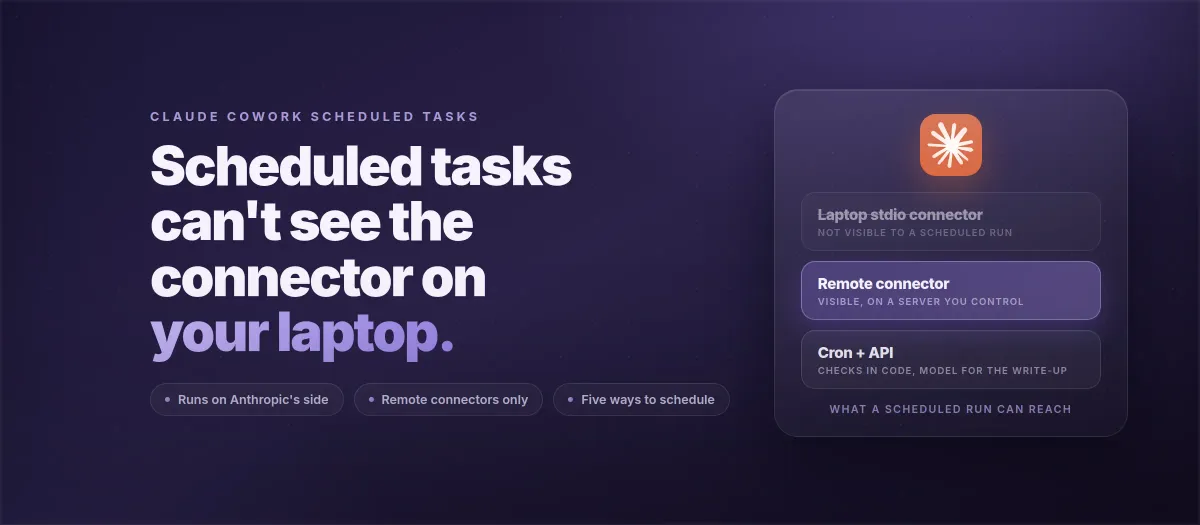
Two firms asked us the same thing in August: can a Claude skill that reads Clio run every morning on its own, with nobody opening the app? One was on Claude Cowork. The other had already written a skill and wanted it running before the office opened. Both had the connector installed the usual way, through claude_desktop_config.json on one person's laptop, and both assumed the scheduler would pick it up.
Anthropic's help centre answers this in one sentence. Scheduled tasks "run remotely, so they run on their cadence even when your computer is asleep or the Claude Desktop app is closed" (Schedule recurring tasks in Claude Cowork). A connector launched from claude_desktop_config.json is a process on that sleeping computer. A task running on Anthropic's servers has no route back to it, so the skill starts, finds no Clio tools, and does whatever a skill does without its tools, which is usually apologise and stop.
What the docs say about where a scheduled task runs
The Cowork help centre, quoted exactly: "Scheduled tasks are available in Cowork for all paid plans (Pro, Max, Team, Enterprise)." They run "hourly, daily, weekly, on weekdays, or manually." They "work with your connectors and the files saved to your Claude account. They can't be tied to a folder on your computer." And the sentence that decides everything: "If a scheduled task requires local files or apps, it will only run locally." The companion article, Get started with Claude Cowork, says where the work happens ("Cowork runs your tasks in the cloud (in beta). Claude's work runs on Anthropic's servers, in an isolated environment") and draws the line for connectors: "plugins that include local MCP servers work through the desktop app only."
Claude Code has the same split, and its Desktop scheduled tasks page puts it in a table. The rows that matter for a practice-management connector:
| Cloud (Routines) | Desktop | /loop |
|
|---|---|---|---|
| Runs on | Cloud, Anthropic-managed by default | Your machine | Your machine |
| Requires machine on | No | Yes | Yes |
| Access to local files | No (fresh clone) | Yes | Yes |
| MCP servers | Connectors configured per task | Config files and connectors | Inherits from session |
The same page is blunt about the local column: "Tasks only run while the desktop app is running and your computer is awake. If your computer sleeps through a scheduled time, the run is skipped." There is a catch-up run on wake, so a 9am task might fire at 11pm, which is fine for a code review and useless for a deadline check. So "connector" means two different things depending on the column. In the Desktop column it can be a program the app launches on your machine over stdio, which is what every laptop install of a practice-management connector is. In the Cloud column it is a remote MCP server with a URL, added to your claude.ai account. The scheduler only ever sees the second kind.
People hit this in the spring
The demand is visible in Anthropic's own issue tracker. By the first week of April 2026, two bug reports on anthropics/claude-code were about connectors in scheduled runs: #40835 (30 March 2026, "Cowork: Creating a new scheduled task disables MCP connectors in existing scheduled tasks") and #43397 (4 April 2026, "Cloud scheduled tasks cannot access MCP connectors"). Both are closed now. What they show is that people expected a scheduled task to carry the same tools as an interactive session from day one. Our two August conversations were the law-firm version of the same surprise.
What "remote connector" means for a Clio integration, and where ours stands
A remote connector is a server that speaks MCP over HTTP (Streamable HTTP or SSE), sits at a URL Anthropic's servers can reach, and holds the Clio OAuth tokens itself. Three things follow: someone has to run that server, its URL has to be reachable from the internet or through something that lets Anthropic's traffic in, and whoever reaches it with the right credential can read the firm's matters through it.
Our connector, @oktopeak/clio-mcp, has shipped an HTTP/SSE mode since v2.0.0, so the transport part is done. The auth part is where we owe you a plain statement. In HTTP mode the endpoint is protected by a static bearer key, MCP_API_KEY, and that variable is currently optional. If it is unset, the endpoint is open: anyone who can reach the URL can open a session. There is no OAuth authorization server in front of it either. The next release makes the key required, so HTTP mode will refuse to start without one, but as of today the safe way to host it is to set the key yourself, put TLS in front, and restrict which addresses can reach it. We'd rather write that here than have a firm learn it from a port scan.
The same questions apply to any self-hosted connector, ours or anyone else's. Before you add a URL as a connector in claude.ai, ask who runs the box, what stops a stranger from calling it, whether the key can be rotated without reinstalling, and where the audit log lands. A vendor that hosts the connector for you and answers all four in writing is a legitimate category with its own trade-offs. A vendor that answers with a shrug is the red flag.
Five ways to run a Claude skill on a schedule, by where the connector lives
1. By hand, in Claude Desktop, with a local stdio connector
The connector lives on the laptop, launched by the app, tokens in the OS keychain, audit log on disk. The "schedule" is a person opening the app at 8am. Most self-installers use our connector this way and it is fine for a solo who is at the desk anyway. The trust questions are the plan's terms for what happens to the prompt (a personal Pro or Max subscription is consumer terms; see which Claude plan a law firm needs) and who else can read that laptop. It can't fire when nobody is there, and it stops the day the person who installed it goes on holiday.
2. A Cowork scheduled task, with remote connectors only
Anthropic runs the schedule and the session. The connector has to be a remote MCP server on your claude.ai account, so it lives on a server somewhere, yours or a vendor's, and nothing on your machine needs to be on. Before trusting this shape, confirm which plan the account is on and what that plan retains, because the scheduled session is an ordinary Claude session on Anthropic's side, and confirm who at the firm can add or remove connectors on the account, since a scheduled task inherits them. Then treat the endpoint's security (the four questions above) as part of the task, because the task is only as private as the URL it calls.
3. A Claude Code Routine, with remote connectors and a repository
Routines are the developer-flavoured version of the same idea. Anthropic announced them on 14 April 2026 as a research preview: a saved prompt, one or more repositories and a set of connectors, fired on a schedule, by an API call, or by a GitHub event, running "on Claude Code's web infrastructure, so nothing depends on your laptop being open." The Routines docs add two things a firm should read twice. A routine runs with no permission prompts, and "Claude can use every tool from an included connector, including writes, without asking for permission during a run." And servers you added locally with claude mcp add "are stored on your machine rather than your claude.ai account, so they do not appear in the connectors list." The docs' workaround for that second point is to declare the server in a committed .mcp.json so it starts inside the cloud sandbox, which puts your Clio credentials in the environment's variables (visible, the docs say, to anyone who uses that environment) instead of the OS keychain. It works, and it is a different trust model, so choose it on purpose. Daily run caps apply, about 5 on Pro, 15 on Max and 25 on Team and Enterprise at the time of writing, and the whole thing assumes a repository, so it suits a firm with a developer or a technical partner already keeping one.
4. A plain cron job against the Clio API, with the model called only for the reasoning step
No MCP connector in this shape at all. A script on a server the firm or its developer controls calls the Clio API directly on a schedule, does the arithmetic in code, and calls Claude through the Messages API only where a judgement or a paragraph is needed. The trust surface is your server, your Clio credentials, and the API's terms. Run it under a zero-retention agreement on the API and the privileged content is neither trained on nor stored after the response, which is the claim you can actually defend. The cost is a developer and a box, and the upside is that nothing about the schedule depends on Anthropic's roadmap or a laptop's sleep settings.
5. The connector itself hosted in HTTP mode on a server the firm controls
This is the piece that makes shapes 2 and 3 possible. The connector runs as a long-lived HTTP service on a firm-controlled server, holds the OAuth tokens there, and any Claude surface that accepts remote MCP (Cowork, claude.ai, Routines) reaches it by URL. The requirements are the ones above and they are not optional: a required key, TLS, a network allowlist or private link, key rotation, and an audit log the firm can read. Our connector meets the transport requirement today and the required-key requirement in the next release; until then you supply the key. A firm that would rather not run a server can have a vendor host it, which is a legitimate choice if the vendor answers the four questions in writing. It is also the shape our firm deployment work delivers; it is one category with one set of costs, and the other four are real.
| Shape | Connector lives | Machine must be on | First thing to check |
|---|---|---|---|
| 1. By hand, Desktop | Laptop, stdio | Yes, and a person | Plan terms for the prompt |
| 2. Cowork scheduled task | Remote server, HTTP | No | Who can add connectors to the account |
| 3. Claude Code Routine | Remote server, or inside the cloud sandbox via .mcp.json | No | Writes run without prompts; daily caps |
| 4. Cron job plus API | None; script calls Clio directly | Your server, yes | Zero-retention terms on the API |
| 5. Hosted connector, HTTP mode | Firm-controlled server | That server, yes | Is a key required on the endpoint |
Where the model belongs in a nightly sweep
Most of the skills firms want to schedule are monitoring skills: which open matters have had no note in 30 days, which deadlines fall inside the next 14, which calendar entries have no time logged against them. Every one of those is arithmetic over dates, and a language model is a poor tool for it. It spends tokens and daily runs on a subtraction a script does for free, it can miscount without telling you which night it did, and you can't audit "the model looked at 340 matters and found nothing" the way you can audit a query with a row count.
The shape that holds up, and that several firms arrive at on their own, is a cheap sweep over every open matter in code, on a cron, producing a short list of flagged items with the numbers attached, and then a deeper pass over only those few. The deeper pass is where the model earns its keep: given a flagged matter, the last three notes, the calendar and the time entries, write two sentences on why the gap exists and what the responsible attorney should do this week. That is drafting and explanation over a handful of records instead of the whole book. So the rule: deterministic checks belong in code, and the model is for the explanation and drafting pass over the items the code flagged. In shapes 2 and 3 that means the skill's first step calls a tool that returns the flagged list rather than paging through every matter. In shape 4 it is the whole architecture.
How to choose
If the skill only has to run when someone is at the desk, shape 1 is fine and costs nothing extra. If it has to fire at 6am with the office dark, you need shape 2, 3 or 4, and each of those puts the Clio credentials somewhere other than a laptop keychain, so the real decision is whose server holds them and what protects the door. If the task has a deadline in it, put the date arithmetic in code and let the model write the note. And if a vendor tells you their laptop install will "just run on a schedule," ask which column of Anthropic's table they think it lives in.
Shape decides where the connector lives. Whether a given skill should run unattended at all is a separate test, and a lawyer gave us the cleanest version of it: which Claude skills can run on a schedule, and which need a person in the chair.
Want the schedule to run without your laptop?
We maintain the open-source Clio MCP server, including its HTTP mode, and we deploy it on firm-controlled servers with a required key, TLS and an audit log as part of firm deployment. If you'd rather talk through which of the five shapes fits your firm first, book a 30-minute call. We'll tell you if the answer is a cron job.
Book a 30-minute architecture call →Worked example The daily routine most lawyers want to schedule is time capture: how the day's work gets posted into Clio once, and why it has to run against a remote connector if it runs unattended.
Frequently asked questions
Can a Cowork scheduled task use the MCP server in my claude_desktop_config.json?
No. A server in claude_desktop_config.json is a process the desktop app launches on your machine over stdio. Anthropic's help centre says scheduled tasks run remotely, on their cadence, even when your computer is asleep or the app is closed, and that tasks needing local files or apps will only run locally. A remote task has no route back to a process on your laptop, so the skill starts without its Clio tools. To schedule it, the connector has to be reachable as a remote MCP server over HTTP.
Does a Cowork scheduled task run when my laptop is closed?
Yes, if everything it needs lives on the Claude side: remote connectors and files saved to your Claude account. Anthropic's Claude Code Desktop docs draw the same line for their local scheduled tasks: they only run while the desktop app is running and the computer is awake, and a run that falls during sleep is skipped. Anything that depends on a program on your machine belongs in the local column, and anything that must fire at 6am regardless belongs in the cloud column with a remote connector.
Which Claude plans include scheduled tasks and Routines?
Cowork scheduled tasks are available on all paid plans (Pro, Max, Team, Enterprise) with hourly, daily, weekly, weekday, or manual frequencies. Claude Code Routines, a research preview announced 2026-04-14, are available on the same plans with a daily cap on runs, about 5 on Pro, 15 on Max and 25 on Team and Enterprise at the time of writing. Both run on Anthropic's infrastructure and both only see remote connectors.
Do I have to host the Clio connector to schedule a skill that reads Clio?
Only if the schedule has to run when your machine is off and you want the skill itself to call Clio through MCP. The alternatives are a Claude Code Desktop local task on a machine you keep awake, or a plain cron job that queries the Clio API directly and calls the model through the API only for the reasoning step. If you do host a connector in HTTP mode, ours included, require an API key on the endpoint, put TLS in front and restrict who can reach it before you add the URL as a connector.