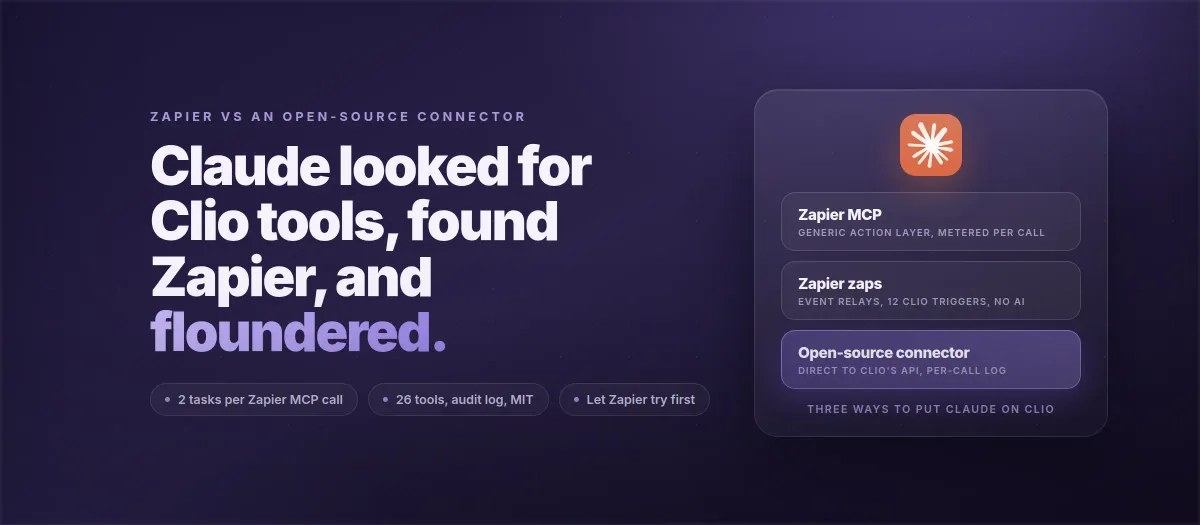
Quick answer: Use a Zapier zap when a Clio event should push something into another app with no AI in the loop; the Clio integration has 12 triggers and 17 write actions. Use Zapier MCP when your firm already runs on Zapier and wants Claude to fire those same actions with nothing installed; each tool call costs two tasks from your plan. Use an open-source MCP connector when the job is asking Claude about your own matters and having it write back, with a per-call record on your machine and no meter. None of the three keeps matter content from reaching the AI provider, and none makes a personal Claude plan suitable for privileged work.
2 tasks
per Zapier MCP tool call, from Zapier's own page; 50 calls on the free plan
34
tools in the open-source Clio connector, v2.0.1, every call logged locally
3 to 0
Zapier recommendations vs open-source connectors named when ChatGPT was asked, 27 July
What does Zapier's Clio integration actually do?
Zapier's Clio listing, checked on 27 August 2026, is wider than the MyCase or Lawmatics listings we've written about: 12 triggers (new or updated matters, tasks, bills, documents, calendar entries, contacts, communications, activities, notes), 17 write actions (create and update matters, tasks, and contacts, plus calendar entries, notes, time and expense entries, document upload, document from template, and assigning a task template list), 8 searches including Find Matter by Custom Field, and 3 find-or-create steps.
A zap is a rule: when this happens in Clio, do that somewhere else. A bill going to Paid posts to the accounting tool; an intake form on the website becomes a contact and a matter. Zapier does that well with no code, and two of those actions do things our connector can't: create a document from a Clio template, and drop a task template list onto a matter. Pricing is per task, one per step that runs, on plans of 100 tasks a month free, 750 for $19.99 a month billed annually, and 2,000 for $69. What a zap can't do is be asked something. It runs when its trigger fires, and "which of my open matters had no activity in thirty days" isn't a trigger.
What does Zapier MCP do that a zap doesn't?
Zapier MCP takes the same action catalog and exposes it to an AI client as tools, through Zapier's hosted server at mcp.zapier.com. Claude connects to Zapier once and can then call Create Task or Find Matter in the middle of a conversation. Nothing gets installed on the attorney's laptop, which matters at a firm whose IT has locked PowerShell down, and the credentials are the ones Zapier already holds for your zaps.
Two properties follow. It's a generic layer: Claude sees Zapier's actions and their descriptions, not Clio's API, and Zapier translates each call. And it's metered. Zapier's MCP page says "Each MCP tool call uses two tasks from your plan's quota", the same bucket your zaps draw from, so the free plan is 50 tool calls a month, Professional 375, Team 1,000. A status sweep where Claude fetches 40 matters one at a time is 40 calls and 80 tasks, most of a free month on one question and about 11% of a Professional month. The record is Zapier's Zap history, a run log kept on Zapier's side; on the call below we didn't find a per-matter audit export in the MCP setup, and if your bar reviewer will want one, that's the first question for Zapier.
The valid use case is a firm already paying for Zapier that wants Claude to create tasks and matters through actions it already relies on, without a Node install. For that firm two tasks a call may be fine, and the last section shows how to find out in ten minutes.
What does an open-source MCP connector do?
Ours is @oktopeak/clio-mcp, version 2.2.0 on npm, MIT licensed. It gives Claude 34 tools across matters, contacts, documents, tasks, calendar, time and expense entries, billing, notes, and users, plus auth and an audit-log export, and it talks to Clio's API directly from the machine it runs on. Login goes through Clio's own OAuth page, so the connector never sees a password; the tokens are encrypted with AES-256-GCM and the key sits in the OS keychain. Every call is appended to ~/.clio-mcp/audit.log as one JSON line (timestamp, tool, arguments with secrets redacted, outcome, Clio user ID, matter ID), and export_audit_log filters that file by date and matter. Two transports: stdio, as a child of Claude Desktop, and HTTP/SSE as a standalone server. Nothing is metered.
The limits cost something to write, so they get their own paragraph. Stdio mode is one attorney on one machine with one token; firm-wide means HTTP mode plus per-attorney sign-in, and in the 2.0.1 build on npm the HTTP server starts without an API key unless you set MCP_API_KEY yourself. The next release refuses to start without one; until it ships, set one. There's no read-only gate: the connector creates matters, tasks, notes, calendar entries, and time entries and uploads documents, and the only thing between Claude and a write is Claude Desktop's per-tool approval prompt, which isn't ours. We told a firm in July that a config-level read-only mode was coming, and it still isn't built. Custom fields on matters aren't readable or writable yet, so Zapier's Find Matter by Custom Field does today what our connector does in 2.1.0 (issue #17; issue #18 covers notes and custom fields on contacts). It's pull-only, so it can't wake up when a matter changes status. And it's an install: Node, a JSON edit, an OAuth login, with Windows traps we describe below.
One more cost of the open-source category: a firm with a technical person doesn't need the vendor. In July a family-law founder in Ontario took the free connector, built the Clio-to-Claude flow he wanted himself, and told us so, politely. If you have someone who can read a README, the connector is the whole product and this comparison ends there.
What did the buyer see on the live call?
August 2026, a Beverly Hills plaintiff firm, one attorney on a screen share. He'd started the install himself and stalled on Windows, so our connector wasn't loaded when the call began. He did already have Zapier connected to Claude. Before we touched anything he asked Claude for his Clio matters, and Claude's visible reasoning went: "I'll look for Clio tools" → "Inspect Zapier Actions" → "Discover Actions." It searched Zapier's catalog for something that looked like Clio, found generic actions, tried to discover more, and never reached a matter. We then fixed the install (execution policy, the placeholder path, two blank credential fields, and Claude Desktop's config living where Settings → Developer → Edit Config says it lives, not where our docs implied), restarted, and the same question came back with his matters. Nobody said a word against Zapier on the call.
The rule we wrote down that night: when a prospect already has Zapier connected, let it try first. The buyer sees the difference between a generic action layer and a tool built against Clio's API in his own session, on his own data, and we never have to make a claim. One caveat we owe you: that's one call, one firm, one untuned prompt. Zapier's catalog may do better with a more specific instruction, and we didn't try to make it look good or bad.
What did the other two buyers say?
A Brooklyn landlord-tenant practice, July. The attorney found us by searching "MyCase MCP", compared Zapier's MyCase MCP against the open-source one, and rejected Zapier's in her words as "limited, read-only, not even an MCP." Her firm had adopted Claude firm-wide a month earlier with nobody technical on staff. Two accuracy notes. Zapier MCP does speak the protocol, so strictly it is one; the tools it showed her were Zapier's actions rather than her practice management system. And that was the MyCase listing; on Clio, Zapier writes plenty, so "read-only" doesn't carry over, while "what does Claude actually see as tools" does.
A nine-attorney Oregon firm, August. They ran a three-way evaluation: Zapier's Clio MCP, a solo automation consultant who'd called them the day before us, and our connector. They picked ours, and the reason had nothing to do with tool counts. In the buyer's words, "you guys have a bit more of an established, larger company", and the consultant's install docs were Mac-only in a Windows office. He'd also hit Clio's API rate limits himself, which is why the connector's 429 handling got said out loud. That call is where we learned Zapier is the competitor buyers have in mind on Clio, not only on MyCase.
What does ChatGPT tell a firm that asks?
On 27 July 2026 we asked ChatGPT, with web search on, "How can a law firm connect Claude AI to MyCase or Clio practice management?" The answer recommended Zapier three times: Zapier plus Claude as option one, Zapier MCP as option two with the phrase "best conversational experience", and Zapier MCP again in the closing recommendation for small and midsize firms. It cited zapier.com, help.clio.com, and help.zapier.com, and named no open-source connector, ours included. That's a fact about what a firm hears when it asks an AI, and a reason to read the vendor pages rather than the summary. The same answer would have sent the Oregon firm to one of the two options it chose against.
Which of the three buyers are you?
You already have Zapier connected to Claude. Let it try first. Ask Claude a real question about a real matter through Zapier MCP, something with a name and a date in it, and watch what it does. Then open your Zapier task usage and see what the question cost. If the answer was right and the meter is fine at your volume, you're done and you installed nothing. If Claude went looking for Clio and found a catalog, you've learned what the Beverly Hills attorney learned, on your own data.
You're evaluating, possibly three ways. Ask every vendor the same questions, us included. What does Claude see as tools, Clio's API or a catalog in front of it? What does one call cost at our volume? Where do the Clio credentials live? Show us the record of one call, exported by matter. Which Claude plan does this assume? What's not built: custom fields, a read-only mode, event triggers, multi-user? Who maintains it, and what happens if they stop? For our connector the last answer is that the code is MIT licensed and you keep it; for Zapier it's a contract; for a solo consultant it's whatever the consultant says, and asking to see the Windows install guide before you decide is fair.
You're putting privileged matter data through this. Count the parties on the data path. A zap is Clio, Zapier, and the destination app. Zapier MCP is Clio, Zapier, and the AI provider. A local connector is Clio, the attorney's machine, and the AI provider. In all three, whatever the tool reads is sent to the AI provider for inference, so the setting that carries most of the weight is the Claude plan: for privileged work that means training disabled and zero data retention, reached through the API or a Team or Enterprise workspace rather than a personal Pro or Max subscription. Then the record: what does the log show for one call, who holds it, and can you hand a bar reviewer the entries for a single matter? A vendor that answers "it's secure" and moves on hasn't answered.
How do the three compare on one page?
| Zapier zaps | Zapier MCP | Open-source connector | |
|---|---|---|---|
| Built for | Event relays between apps | AI firing Zapier actions | AI working with Clio data in conversation |
| What Claude sees | Nothing; no AI in the loop | Zapier's action catalog | 34 tools built on Clio's API |
| Reacts to Clio events | Yes, 12 triggers | Through zaps, not through Claude | No, pull-only |
| Custom fields | Search by custom field | Same searches as zaps | Not until 2.1.0 (issues #17, #18) |
| Cost of use | 1 task per step; 100 free, 750 at $19.99 | 2 tasks per tool call | $0, no meter, MIT |
| Where it runs, who holds credentials | Zapier's cloud, Zapier | Zapier's cloud, Zapier | Attorney's machine; token encrypted, key in OS keychain |
| Record of each call | Zap history | Zap history; ask about per-matter export | Local JSONL log, exportable by date and matter |
| Read-only mode | Choose read-only steps | Choose which actions to expose | None; Claude Desktop's approval prompt only |
| Multi-user | Yes, Zapier team plans | Yes | HTTP mode; set an API key on 2.2.1 yourself |
| Setup | Point and click | Connect once, no install | Node, one JSON edit, OAuth; Windows has traps |
Where that leaves a Clio firm: a zap for anything event-shaped with no AI in it; Zapier MCP if you're already on Zapier, the meter works at your volume, and Claude answers your test question through it; an open-source connector when the work is conversational, you want the per-call record on your own machine, and someone can get through the install. A zap and a connector can run side by side on the same Clio API without touching each other.
Want to run the test on your own Clio account?
We built the open-source Clio MCP server, it's free whether or not you ever talk to us, and the setup guide shows every step. If you'd rather not do the install alone, we walk the first attorney through it on a screen share at no cost, Zapier try-first included if you already have it connected. Bring a real matter to ask about.
Book a 30-minute setup call →Frequently asked questions
Does Zapier have a Clio MCP?
Yes. Zapier MCP exposes Zapier's Clio action catalog to AI clients such as Claude as tools, through Zapier's hosted server at mcp.zapier.com. It is the same catalog Zapier's Clio zaps use: 17 write actions, 8 searches, and 3 find-or-create steps. Claude sees Zapier's actions rather than Clio's API, and Zapier translates each call. Nothing is installed; the trade is that credentials and traffic run through Zapier's cloud and every tool call is metered against your task quota.
How much does Zapier MCP cost per tool call with Clio?
Zapier's MCP page states that each MCP tool call uses two tasks from your plan's quota. On Zapier's published plans as of August 2026 the Free plan (100 tasks) covers 50 tool calls a month, Professional at $19.99 a month billed annually (750 tasks) covers 375, and Team at $69 a month (2,000 tasks) covers 1,000. One question that makes Claude fetch 40 matters one by one is 40 calls, or 80 tasks. An open-source connector on your own machine has no meter; the only subscription in the loop is the Claude plan you already pay for.
Is an open-source Clio MCP connector safer for privileged client data than Zapier?
The difference is the number of parties on the data path, not whether content stays put. With Zapier MCP, Clio credentials are held by Zapier and matter data transits Zapier's cloud before reaching the AI provider. With a local connector, data moves between the attorney's machine, Clio's API, and the AI provider, with the OAuth token encrypted on that machine. In both cases whatever the tool reads is sent to the AI provider for inference, so the setting that matters most is the Claude plan: for privileged work, training disabled and zero data retention, reached through the API or a Team or Enterprise workspace rather than a personal Pro or Max subscription. Then ask each option for the record of one call, exportable by matter.
What can't the open-source Clio MCP connector do today?
As of version 2.0.1 on npm: stdio mode is one attorney on one machine with one token. The multi-session HTTP mode starts without an API key unless you set MCP_API_KEY yourself; the next release refuses to start without one. There is no read-only gate; the connector can create matters, tasks, notes, calendar entries, and time entries and upload documents, and the only thing between Claude and a write is Claude Desktop's per-tool approval prompt. Custom fields on matters and reading notes arrive in 2.1.0 (GitHub issues 17 and 18). It is pull-only, so it cannot react to a Clio event the way a Zapier trigger does.
Sources: Zapier's Clio integration listing, Zapier MCP for Clio and the Zapier MCP page, Zapier's published pricing, and the @oktopeak/clio-mcp README, changelog, and open issues on GitHub, all checked 27 August 2026. Every one of them changes, so verify against the live pages before you commit. Firm descriptions are deliberately general; the quotes are as said on the calls.