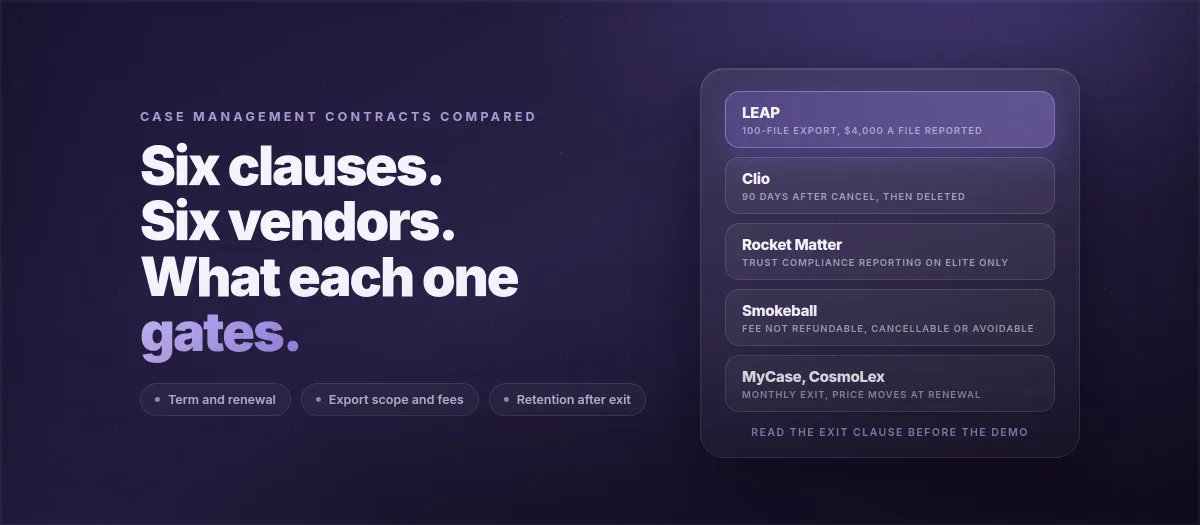
Quick answer: six clauses decide lock-in, and none sit on the pricing page. Term: MyCase is month to month; Clio and CosmoLex renew for the term you signed; Smokeball's 12- or 36-month fee is "not refundable, cancellable, or avoidable"; LEAP's UK customers report 3-year terms. Renewal: all six auto-renew, and Smokeball needs 30 days' notice or it renews for 12 months. Price: Rocket Matter "may modify subscription fees or impose additional fees at any time"; MyCase, Smokeball and CosmoLex hold it for the term and move it at renewal. Export: LEAP users report a 100-file cap and a $4,000-per-file quote. Retention: 30 days at MyCase and Smokeball, 90 at Clio, within 180 at Rocket Matter, seven years at LEAP behind a reactivated subscription. API: Clio and Rocket Matter document one on every plan; MyCase gates it at $130 per user, Smokeball behind Prosper+; CosmoLex and LEAP publish none.
$4,000/file
the LEAP export quote users report on Lawyerist, past a 100-file self-service cap
30 to 180 days
how long data survives cancellation at MyCase, Smokeball, Clio and Rocket Matter
$145/user/mo
the Rocket Matter tier where "Comprehensive Financial and Trust Compliance Reporting" lives
Where a row quotes a contract, we read it on 27 August 2026 and link it. Where a row says "reported", the claim comes from a user review or a migration vendor and isn't in a document the vendor signs. Weigh the two differently. We build integrations and migration tooling for law firms and don't resell any of the six.
Ownership matters because contract language travels with the owner. ProfitSolv (Lightyear Capital) owns CosmoLex and Rocket Matter, with Tabs3 and TimeSolv beside them. Christian Beck's ATI owns LEAP and, since October 2025, Smokeball. 8am, the AffiniPay brand, owns MyCase with LawPay and CASEpeer. Clio has no sibling in the table. A move from CosmoLex to Rocket Matter, or Smokeball to LEAP, stays inside one portfolio, and Universal Migrator uses the same three phrases, disabled user accounts, throttled download speeds, blocked IP addresses, on its Smokeball page and its LEAP page.
How long is the term, and what do you owe if you leave in the middle?
| Vendor | Term and mid-term exit | Source |
|---|---|---|
| Clio | Monthly or annual. "All charges are final, non-refundable and where applicable, non-cancellable." No cancel button: live chat, then a cancellation team and a case number. | ToS; our own cancellation, June 2026 |
| MyCase | Monthly or annual. "No long-term contract or setup fee is required." Cancel in Settings; active to the end of the cycle; paid fees non-refundable. | Pricing, help center |
| Smokeball | Term set on the Client Order Form, commonly 12 or 36 months. The fee "is a fixed fee for the entire Subscription Term and is not refundable, cancellable, or avoidable", including for "reasonable delays in Migration" (clause 3). | ToS; term lengths reported by users |
| CosmoLex | Renews for successive terms. Cancel any time; "THERE WILL BE NO REFUNDS OF PREPAID SERVICES FEES." | Agreement |
| Rocket Matter | Priced "Paid Annually". "We don't issue refunds or pro-rated credits." No term length or notice period stated. | Agreement |
| LEAP | Terms not published. UK users report 3-year contracts and a £12,000 bill to terminate for two users. | Reported: Trustpilot, Capterra, 2024 to 2026 |
The mid-term question is really how much you prepaid. All six keep prepaid money; what differs is the size of the prepayment: a month at MyCase, a year on Clio annual, up to three years at Smokeball and, by user accounts, at LEAP in the UK. Smokeball's clause 3 is explicit that a migration which never finishes doesn't release you, which is what one Lawyerist reviewer described: paid for migration in May 2022, no working product by February 2023, still bound.
What happens at renewal?
| Vendor | Renewal clause | Source |
|---|---|---|
| Clio | "Automatically renew for successive terms equal in length to your initial term, until cancelled." | ToS |
| MyCase | "Automatically renew on a monthly or annual basis." Cancel any time in Settings. | 8am ToS |
| Smokeball | Renewal form 60 days out. Notify 30 days before the end date or it "will automatically renew as a 12-month subscription" (clause 9). Seats drop "only at the time of Renewal" (clause 6). | ToS |
| CosmoLex | "SHALL AUTOMATICALLY RENEW FOR SUCCESSIVE TERMS UNTIL YOU CANCEL YOUR SUBSCRIPTION." Either party may decline to renew. | Agreement |
| Rocket Matter | No renewal or notice clause in the agreement we read. | Agreement |
| LEAP | Users report auto-renewal and a cancellation notice unacknowledged for two months. | Reported: Trustpilot |
Renewal is where the seat count freezes. Smokeball writes it into clause 6, and it's the clause that bites a firm which loses a paralegal in month four of a 36-month term: that seat bills for 32 more months. Renewal is also when the price moves, so the date on the order form deserves a reminder 90 days out at every vendor here.
Who can change the price, and when?
| Vendor | Price-change right, and the price today | Source |
|---|---|---|
| Clio | "All fees are subject to change upon notice." Features may change "with or without notice" (section 17.5). Annual Complete moved to $1,609.20 per user, per a lawyer on r/LawFirm. | ToS; price reported, 2025; our Clio cost breakdown |
| MyCase | Changes "by providing prior written notice", effective "at the start of the next subscription period." On 27 August 2026: Basic $50, Pro $100, Advanced $130 per user per month annual ($60, $120, $150 monthly). Our May breakdown recorded $39, $89, $109. | 8am ToS, pricing |
| Smokeball | Fees "fixed during the Subscription Term but may be increased for any subsequent Subscription Term" (clause 3). Bill $49 and Boost $89 published; Grow and Prosper+ quote-only. A G2 reviewer after a 36-month term: renewal fees "nearly DOUBLED." | ToS; renewal reported on G2 |
| CosmoLex | "Subsequent to the initial term of your subscription, we may increase Service Fees to be effective for the subsequent renewal term." Today Core $99, Pro $129, $120 a year off with annual. A Capterra user since 2017: "All they do is increase prices." | Agreement, pricing; trajectory reported on Capterra |
| Rocket Matter | "We may modify subscription fees or impose additional fees at any time." Paid annually: Essentials $59, Pro $95, Premier $115, Elite $145. Lawyerist's current review still lists $49, $79, $99, $129. | Agreement, pricing, Lawyerist |
| LEAP | No published pricing or terms. Third-party sources put US pricing near $149 per user; one Trustpilot reviewer pays £378 plus VAT a month for one user. | Reported, 2025 to 2026 |
Two clauses that read alike aren't. "Fixed during the term, may increase at renewal" (Smokeball, CosmoLex, in effect MyCase) means the order-form number holds until the term ends. "May modify at any time" (Rocket Matter) has no floor. Both move at renewal in practice, and two of the six moved between our last check and this one: MyCase's annual tiers rose $11, $11 and $21 per user per month between 13 May and 27 August 2026, and Rocket Matter's rose $10 to $16. Neither breaches anything. The first means our own MyCase post needs a correction, which we'll make.
The other half of price is the tier that carries the feature you need, because that's the number the contract locks. Rocket Matter's pricing page puts "Reconcile Operating, Trust, and Credit Card Accounts" and "Comprehensive Financial and Trust Compliance Reporting" under Elite only, so trust compliance reporting inside the platform is a $145 decision, not a $59 one, and LEDES starts at Premier ($115). MyCase's Open API sits on Advanced. Smokeball's AutoTime is on Prosper+ or a paid add-on to Grow, both quote-only. Packaging this way is a vendor's right; the mistake is comparing one platform's entry price against another's working tier.
What can you export, and what does it cost?
| Vendor | Export scope and fees | Source |
|---|---|---|
| Clio | CSV for contacts, matters, bills; documents by API or per-matter download; trust balances leave as "a single line item representing the summative balance." No fee, no reported interference. | Clio migration docs; our backup guide |
| MyCase | Self-service export. Users report the document backup is metadata only and "there is NO WAY to migrate all the invoicing and trust accounting out of the system." | Reported: user reviews, 2024 to 2025 |
| Smokeball | 30 days after the term "for the sole purpose of permitting You to retrieve Your data" (clause 15). Documents stored as "1357219.pdf". Consultants report "disabled user accounts, throttled download speeds, blocked IP addresses." | ToS; Universal Migrator |
| CosmoLex | Excel or CSV per module; financials as balances on a chosen date, "in the form and format provided by our software." | Agreement, support |
| Rocket Matter | CSV via Advanced Search. You must "remove and/or backup Your Data prior to the termination or expiration of the paid term." Backend filenames need renaming. | Agreement; filenames reported by migration vendors |
| LEAP | Export "limited to only 100 files so you have to call leap." "They want to charge $4,000 to export a single file!! Daylight robbery." Universal Migrator needs a dedicated admin login and a VPN: "plan for delays you can't fully anticipate." LEAP's policy: it "will enable The Subscriber to extract Personal Data on request." | Reported: Lawyerist; Universal Migrator; LEAP policy |
One vendor has a per-file fee attached to it, and it lives in user reports rather than in anything LEAP publishes; LEAP's policy language points the other way, which is why the fee, or its absence, goes in writing before signing. Everywhere else the cost is friction: numeric filenames, trust ledgers that leave as a balance instead of a history, a 30-day window that closes before your first month-end on the new system. No platform here exports transaction-level trust history, so print the last reconciled ledger to PDF while you still have a login. The order of operations is in what it costs to leave Clio, and it holds for the other five.
How long does your data survive after you cancel?
| Vendor | Retention after cancellation | Source |
|---|---|---|
| Clio | "No less than ninety (90) days from the cancellation or termination", then "all Content associated with such subscription will be irrevocably deleted." | ToS |
| MyCase | 30 days read-only after the cycle ends, then data "will be deleted after the 30-day read-only access period unless exported beforehand." The ToS lets 8am delete "all associated Customer Content" on termination. | Help center, 8am ToS |
| Smokeball | 30 days to retrieve (clause 15); Smokeball "may delete Your account and data after thirty (30) days" (clause 14). | ToS |
| CosmoLex | "At least thirty (30) days" when CosmoLex terminates or declines renewal. No window stated for when you cancel. | Agreement |
| Rocket Matter | "We may delete all of your data within 180 days." Restoration inside 90 days is "occasionally possible", may carry fees, and is "not guaranteed." | Agreement |
| LEAP | Data retained "for a period of seven (7) years before having it destroyed"; "a subscription can be reactivated to gain access." Users: no active contract, no access. | LEAP policy; access reported on Trustpilot |
Read this against your bar's record-keeping rule, five to seven years in most US states. LEAP's window is the only one longer than any bar rule, and it's access by reactivated subscription: the retention is real and the door has a meter. Thirty days is one billing cycle; if the first month-end close on the new system turns up a gap, the MyCase or Smokeball data is already gone, so the export finishes before notice is given. Clio's 90 and Rocket Matter's 180 are the comfortable windows, though "within 180" can also mean sooner.
Can your own developer reach the data through an API?
| Vendor | API access | Source |
|---|---|---|
| Clio | Public, documented, OAuth, four data regions, every plan. | Developer docs; our Clio connector |
| MyCase | "Open API" on Advanced only, $130 per user per month annual. | Pricing; our MyCase connector |
| Smokeball | Docs public at docs.smokeball.com. For a firm's own app: "Your firm must be on the Smokeball Prosper+ plan", have developers, and apply. Prosper+ has no public price. | Support hub |
| CosmoLex | Section 7.5 authorises API use. No public developer documentation found; Zapier is the workaround firms describe. | Agreement; gap reported by users |
| Rocket Matter | developer.rocketmatter.com: contacts, matters, time entries, expenses. Zapier on Premier and Elite. | Developer docs, pricing |
| LEAP | Partner-oriented; users call it "buggy"; no Zapier. | Reported, 2025 |
The API is the quiet exit door. With it, a nightly backup to the firm's own storage is a small script and a migration is an engineering job with a test run. Without it, the export is a screen, a ticket, and whatever the 30-day window allows. MyCase's door costs the Advanced tier on every seat, $3,600 a year more than Pro for a 10-user firm; Smokeball's is a plan with no published price. Neither is unreasonable for a firm that won't leave or build. The firm that wants the door in year three, after two price moves, should count it now.
Which vendor fits which firm
Clio fits a firm that wants the widest integration set and a documented API on every plan, and accepts an annual commitment that doesn't refund and a cancellation that goes through support. Its monthly plan is the cheapest exit here. MyCase fits a solo or small firm that values leaving in-app on a month's notice above everything else in the six tables; the trade is a 30-day deletion clock, an API on the top tier, and a price that has moved with notice and, by one r/LawFirm account, once without it, when a solo was moved from a $49 tier to $89 and billed again 11 days after a written downgrade.
Smokeball fits a Windows-based, document-heavy practice where 20,000-plus automated forms and AutoTime pay for themselves inside the term, signed knowing the fee isn't cancellable, seats only drop at renewal, and migration delays don't release it. Ask for 12 months rather than 36. CosmoLex fits one to ten attorneys who want the ledger inside the practice system instead of a QuickBooks sync, with a CPA who has agreed to work in it. Its agreement is the only one promising modifications "will not result in a diminution of the functionality or quality of the Services"; leaving means rebuilding accounting elsewhere from balances.
Rocket Matter fits a firm that wants strong time tracking and a documented API at $59, with the longest deletion window of the US five; if you need trust compliance reporting inside it, compare at $145. LEAP fits conveyancing and estate practices where 13,000-plus jurisdiction-specific forms and the InfoTrack pipeline are the point, and that value is real. The exit terms are what to negotiate before signing: term, termination fee, export scope and any per-file charge, access once the term ends. None appear in a document you can read today, so get each one as a clause.
Five questions to ask before signing, whichever vendor
- What's the term, and what do I owe if I leave in month four? Ask for the clause number. Monthly, annual and multi-year are all legitimate; "we'll work something out" is the answer to get in writing.
- How much notice do you need not to renew, and can my seat count go down at renewal? Thirty or sixty days is normal. A rep who can't say when the renewal notice goes out hasn't read the order form.
- Can the price change inside my term, and what notice comes at renewal? Then ask for my tier's list price in each of the last three years. Every vendor here has raised prices; the signal is whether they'll say by how much.
- Show me a full export from a firm my size. Named documents or numbers, trust transactions or only balances, notes and emails, any per-file or per-hour charge. A sample export answers this in ten minutes.
- After I cancel, how long can I log in read-only, and is there an API on the plan I'm buying? Both have a number attached. Hedging is the signal, not which category the vendor is in.
Want a second pair of eyes on a contract or an export?
We build integrations, backups and migration tooling for law firms on Clio, MyCase and the platforms above, and we don't resell any of them. If you're about to sign, or about to leave, and want someone to read the clauses against what the export actually contains, book a 30-minute call. We'll tell you which rows in these tables apply to your firm and which don't.
Book a 30-minute call →Frequently asked questions
Which law practice management software has the hardest exit terms?
It depends on the clause. On export, LEAP is the outlier: users on Lawyerist report a 100-file self-service cap and a $4,000 quote to export a single file, and Universal Migrator reports disabled accounts, throttled downloads and blocked IP addresses during LEAP and Smokeball migrations. On term length, Smokeball's 36-month contracts and the 3-year terms LEAP's UK customers report are the longest. On retention, MyCase and Smokeball delete after 30 days, Clio after 90, Rocket Matter within 180. Clio and MyCase are the easiest exits: monthly plans, self-service export, no reports of interference.
Can you cancel Clio at any time?
On a monthly plan, yes, through support. Clio's terms renew subscriptions automatically for terms equal to the initial term, and all charges are final, non-refundable and, where applicable, non-cancellable, so an annual plan bills to the end of its term. There's no cancel button: in June 2026 we cancelled a Clio account ourselves and it took a live chat, a request to a separate cancellation team, and a case number. Clio then keeps your data for no less than 90 days and deletes it irrevocably.
Does LEAP charge to export your data?
We found no per-file fee in any LEAP document; LEAP's information security policy says it will enable a subscriber to extract personal data on request and retains data for seven years after termination. Users report otherwise: Lawyerist community reviews describe export limited to 100 files, pulling data one matter at a time, and a $4,000 quote to export a single file, which one reviewer called daylight robbery. Universal Migrator tells consultants to expect disabled accounts, throttled downloads and blocked IP addresses. Get export scope, any per-file fee and post-term access in writing before signing.
Which practice management platforms have a public API?
Clio documents a public OAuth API on every plan, in four data regions. Rocket Matter publishes docs at developer.rocketmatter.com. MyCase lists Open API under Advanced only, $130 per user per month on annual billing as of 27 August 2026. Smokeball publishes documentation, but its support hub says a firm must be on the Prosper+ plan, which has no public price, and apply. CosmoLex's agreement authorises API use but we found no public developer documentation; Zapier is the usual workaround. LEAP's API is partner-oriented and users call it buggy.