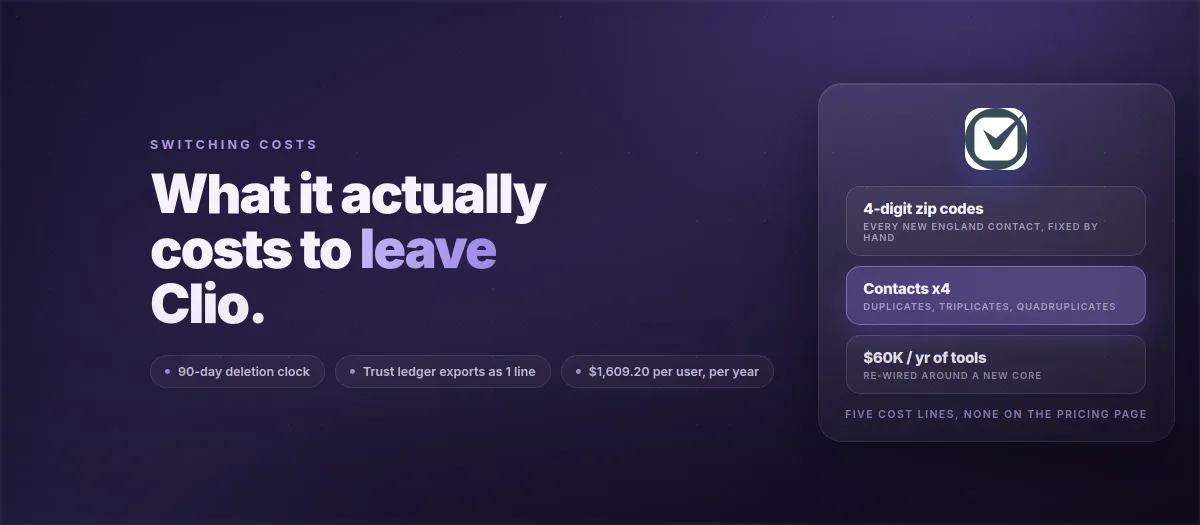
Quick answer: leaving Clio costs five things, and only the first shows up anywhere near an invoice. Export gaps: contacts and matters leave as CSV, documents need the API or a manual download per matter, and the trust ledger leaves as one summary balance per client. Cleanup of fields the move breaks, like every New England zip code losing its leading zero. Duplicate contacts, already multiplied by one-way integrations into "duplicates, triplicates, and even quadruplicates." Re-wiring every tool connected to Clio, a stack costing about $60,000 a year at a nine-attorney firm we spoke with. Staff time for the dual-run and retraining. The number that starts the conversation, the annual Complete plan at $1,609.20 per user, is the only one of the five with a receipt.
$1,609.20
per user, per year, the annual Complete price lawyers report; the line that starts the conversation
90 days
how long Clio keeps your data after you cancel, then deletes it for good
1 line
what a client's trust history exports as: a summary balance, no transactions
Why do firms stay on software they say they hate?
The thread is titled "MyCase v. Clio (v. Other)?" and its comments run into 2025. The lawyer quoted above goes on: "I hate Clio so much... they're not going to redo the entire thing because profits." Another poster, different firm, same conclusion: "Still trucking along with Clio because I can't stomach migrating again. I just hate it." Both have done at least one migration already, so they're pricing the next one from memory, and the memory outweighs the dislike. The migration is a second subscription, paid in full on the day you leave, and most firms never leave because nobody has itemised it for them.
What comes out of Clio, and what doesn't?
Clio has two exits, and they don't reach the same data. The interface exports contacts, matters and most list views as CSV and lets you download documents one matter at a time. The API reaches everything the platform stores, at a pace we'll get to. The backup version of this is in how to back up Clio data; a migration has the same shape with a harder deadline.
| Data | Native export | API | What goes wrong |
|---|---|---|---|
| Contacts, matters | CSV | Yes | The CSV passes through a spreadsheet: zip codes become numbers, dates get reformatted. |
| Documents | Manual, per matter, no folder tree | Yes, one request per file for the link, then the file | Folder hierarchy must be rebuilt from the folder records or the files land in a heap. |
| Notes, time entries, activities | Partial, via list views | Yes | Records carry matter and user ids; without the id-to-name map the new system can't attach them. |
| Logged emails | Awkward in bulk | Yes | Volume. Years of logged mail is often the largest object count in the account. |
| Custom fields | As CSV columns | Yes, definitions and values separately | Each value has its own id, distinct from the definition's id. Mix them up and values land on the wrong field. |
| Trust ledger | One summary balance per client | Check what your account exposes | Deposits, disbursements and transfers don't come with the balance. A bar audit asks for the transactions. |
The trust row is the one to take seriously. Our Clio cost breakdown covers the terms; for a migration, the point is that the transaction history behind each client's balance stays behind unless you go and get it. Whatever the API gives you, print every client's trust ledger to PDF from inside Clio before the account closes and file the PDFs with the closing reconciliation. It's a day of clerical work, and it's the day that answers a bar auditor three years from now.
Then there's the clock. Clio's terms keep your data for 90 days after cancellation and then delete it irrevocably, and the same terms make charges final, non-refundable and non-cancellable. So the export happens before you give notice, and on an annual plan the switch is timed to the renewal date, because months already paid for don't come back.
How long does the export take?
Long enough to plan around. The Clio API allows roughly 3 requests a second per app (Clio's documentation still references a 50-requests-per-minute figure), and going over gets you an HTTP 429 with a Retry-After header. Every document needs its own request for a download link before the file can be fetched, so a firm with 40,000 documents in Clio, ordinary for a ten-year-old practice with logged attachments, is looking at about 3.7 hours of link requests at 3 a second, or over 13 hours at 50 a minute, before the bytes move and before matters, contacts, notes and emails are pulled at all. The batch design is in the rate limits post; the export is an overnight job that has to survive interruption, and a script that restarts from record one on every 429 never finishes.
What migration errors do people actually report?
The most specific story in the thread is a Clio migration that "dropped the leading zero from every New England zip code." Every zip code in Massachusetts, Connecticut, Rhode Island, Vermont, New Hampshire and Maine starts with a zero, and so does every one in New Jersey. Somewhere between the two systems the zip column passed through something that treated it as a number, 02134 became 2134, nothing errored, and the firm found out when the mail came back. The same poster listed what arrived alongside the four-digit zips: duplicate contacts, file numbers that hadn't been cleaned up, "zero guidance," and a support ticket that went quiet.
That case is the shape of almost every migration defect: the value was right in the source, valid in the target, and the step in between changed its meaning with nobody checking for that particular change. Counting rows passes this migration. A one-line rule (any zip under five digits in a state whose zips start with zero) catches it in seconds, and you only write that rule if you already know the failure exists. That's the real value of the thread: rules other people paid for.
Two other quotes explain why the defects surprise people. "Both Clio and MyCase oversell everything. When you actually get the software, it doesn't really do what you want at all." And from a lawyer who lasted a day: "I paid for Clio and dropped it within a day... disgusted that some demo with no data sold me on that worthless software." A demo runs on clean sample data. The migration is the first time the product meets your real contacts, your file numbering, and the custom fields your intake person invented in 2019.
The third pattern is duplicates, and it usually predates the migration. One poster "bailed on Clio due to the integrations being so many that they became cumbersome," with one-way syncs producing "duplicates, triplicates, and even quadruplicates" of contacts. Two tools each believe they own the contact, an edit in one comes back to the other as a new record, and after a few years the same client exists four times with four slightly different phone numbers. A migration copies all four faithfully, and deduplicating is a judgment call per record, which means a person, which is why it's the largest staff-time line in most moves.
What does it cost to re-wire everything connected to Clio?
A nine-attorney firm we spoke with this summer spends about $60,000 a year across Clio, Lawmatics and the rest of its practice software. That's the firm's own number, and it's the right one to keep in mind, because Clio is rarely alone. Lawmatics runs intake and hands new matters to Clio, QuickBooks syncs for the books, and then there's the e-signature tool, the Zapier automations, the document templates, the client portal links in every engagement letter, and the outside-built reports. One PI lawyer in the thread, eight years in, wrote that Clio was "not built for contingency models" and "we've had to pay outside vendors to design reports outside of the system." Those reports point at Clio's data layout, so they're rebuilt or they're gone.
Each connection has a person who set it up and a different person who knows how it breaks, and the migration needs both. Stored cards don't travel between payment processors, so every recurring payment plan is set up again with the client. For a firm that size, the re-wiring line is most of a $60,000 stack being re-plumbed around a new core while the practice keeps running.
Does the $120-a-month DIY stack math hold up?
One lawyer in the thread replaced Clio with Insightly, Dropbox Business, Google Workspace, Formstack and eFax, wired together with Zapier, at about $120 a month for a 10-to-12 person office. He says it "saved about $50,000 a year in tech fees" against Clio, which he priced at around $850 a month for four users. Both figures are his, and they don't close on their own: $850 a month is $10,200 a year, so the $50,000 includes something he didn't itemise, and $120 a month for a dozen seats of Workspace plus Dropbox plus a CRM is either a legacy plan or leaves a tool out. The stack may still be a good idea. The number is a mood, and a firm copying it should build its own line items.
The more useful contribution is the reply from another poster, who said billing, trust and calendaring without a practice-management system "quickly becomes a nightmare." He's right, and the reason is specific. A CRM and a file share replace the easy parts of Clio: contacts, documents, intake forms. What they leave you to build is the three-way trust reconciliation you owe the bar every month, the conflict check across every contact the firm has ever touched, court-rule calendaring, and invoices built from time entries tied to matters. Those pieces are what make Clio hard to leave, and a Zapier-wired stack reproduces them worst, because Zapier is exactly the one-way sync that produced the quadruplicate contacts above. The DIY stack works for a flat-fee practice with light trust activity. For an hourly practice holding client funds, the nightmare quote is the accurate forecast.
How do Clio's exit terms compare with LEAP and Smokeball?
This is the part that's fair to Clio. We researched the exit terms of the second-tier platforms for our own competitive work, and the comparison changes how the Clio numbers read.
| Exit term | Clio | LEAP | Smokeball |
|---|---|---|---|
| Public API | Yes, documented, OAuth | No single database; a competitor notes "LEAP cannot provide a complete backup" | None |
| Self-service export | CSV for records, manual document download | Limited to 100 files; users report $4,000 per file beyond that | Documents stored under filenames like 1357219.pdf |
| Behaviour during a migration | No reports of interference | Universal Migrator: "disables user accounts, throttles download speeds, and blocks IP addresses" | Universal Migrator: developers "intentionally interrupt migration plans," same three tactics |
| Data after cancellation | Kept 90 days, then deleted | Retained 7 years, access only with a paid subscription | Fee "not refundable, cancellable, or avoidable," even when migration never completes |
| Contract | Annual, non-refundable, non-cancellable | 3 years in the UK; termination fees reported up to £12,000 for two users | 12 or 36 months; one reviewer paid for migration in May 2022 and had no working product by February 2023 |
Read across the rows and Clio's exit is one of the better ones in the market. There's a public API, there's a CSV export, and nobody in any forum we've read reports Clio throttling downloads or locking accounts while a firm leaves. The cost of leaving Clio is mostly the cost of your own data being messy, plus a 90-day clock and a contract that doesn't refund. Leaving LEAP or Smokeball adds a vendor working against you and a per-file fee that turns a document library into a ransom note. If either is your destination, its exit terms deserve more weight than the price of the place you're leaving. All six vendors' clauses side by side: case management contracts compared.
Who shouldn't migrate?
Some firms should read this and stay. If the complaint is price alone and the firm has a handful of users, the cleanup, dedupe and re-wiring lines above will usually cost more than a year of the increase to $1,609.20 a seat, and a renewal negotiation is cheaper than a move. If the trust history has never been reconciled outside Clio, reconcile first and move later; a mid-year migration with an unreconciled ledger is how bar complaints start. If the destination is MyCase and the reason is a feature from a demo, the thread has a warning: the poster who said both vendors oversell everything is joined by others describing MyCase leaving a batch-billing tax-decimal bug unfixed for over a year and silently moving a solo from a $49 tier to $89. And if nobody in the firm will own the reconciliation counts and the dedupe decisions, "zero guidance" is what you'll get, because no vendor's migration team knows your file numbering.
How do you leave without the mess?
The order matters more than the tooling. Every defect above came from doing the steps in the wrong sequence: cancel first, export second, fix in production third.
- Export through the API before you give notice. Matters, contacts, documents with their folder tree, notes, communications, time entries, custom fields with their definitions. Overnight, resumable, honouring every 429. Print each client's trust ledger to PDF the same week.
- Reconcile counts against Clio's own screens. Matters, contacts, documents per matter, sum of trust balances, written down. Every error above shows up here: short zip codes are one rule, duplicates are a match on email or phone, orphaned time entries are a join that fails.
- Fix in the staging copy, never in the new system. Dedupe, pad the zip codes, normalise the file numbers, and log every change so a partner asking "why does this client have one record now" gets an answer.
- Load, then run both systems for one billing cycle. Time goes into the new system, the invoice run is compared line by line with what Clio would have produced, and trust balances are reconciled in both.
- Keep Clio read-only for a month after go-live. Cancel after the first full month closes cleanly, timed to the annual renewal, so the 90-day clock starts with nothing left to fetch.
- Re-point integrations one at a time, with one owner per record type. Every sync flows from the owner outward, which is what stops the quadruplicates from coming back within a year.
In that order, four of the five cost lines become a few days of scripted work plus a few days of a paralegal's judgment, and the fifth becomes a calendar decision about the renewal date. In the other order, they become the reason the next lawyer posts that he can't stomach doing it again.
Want the export and reconciliation done before you give notice?
We build Clio export and migration pipelines on the same API patterns as our open-source Clio connector: full pull with folder tree, resumable batches, reconciliation counts, a staging copy you can inspect, and a change log for every fix. The standard pattern starts where our Clio Backup service does; a migration with dedupe and dual-run is scoped after a call. Discovery is free: 30 minutes, a draft scope, a rough number.
Book a 30-minute call →Frequently asked questions
How much does it cost to leave Clio?
There's no exit fee. The cost is five lines that never appear on an invoice: the data the export leaves behind (documents without their folder tree, the trust ledger as a summary balance), cleanup of fields the move breaks (zip codes losing their leading zero, file numbers), deduplicating contacts that one-way integrations multiplied, re-wiring every tool connected to Clio, and staff time for the dual-run and retraining. For a nine-attorney firm spending about $60,000 a year across Clio, Lawmatics and the rest of its practice software, the re-wiring line alone touches most of that budget. Any annual Clio contract still running is non-refundable, so timing the switch to the renewal date is part of the cost.
What data can't you export from Clio?
Clio's native export gives you contacts, matters and most list views as CSV, and documents as manual per-matter downloads without the folder hierarchy. Trust accounting leaves as a single summary balance per client; the individual deposits, disbursements and transfers don't come with it. Logged emails and activity logs are awkward to pull in bulk through the interface. The API reaches matters, documents, notes, contacts, calendars, communications and custom fields, so a scripted export gets you further than the buttons do, but it runs at roughly 3 requests a second and takes hours on a real document library.
What happens to your data after you cancel Clio?
Clio's terms keep your data for 90 days after cancellation, then delete it irrevocably. Charges are final, non-refundable and non-cancellable, so an annual plan keeps billing to the end of its term whether or not you're using it. The practical rule is to finish the export and reconcile it before giving notice, keep Clio read-only for at least a full billing cycle after the new system goes live, and print each client's trust ledger to PDF while you still have access. Your obligation to keep client records outlasts the 90 days.
Is switching from Clio to MyCase worth it?
Only if there's something Clio can't do for the firm; a feature seen in a demo is a weak reason. A lawyer in the same r/LawFirm thread that produced the migration stories wrote that both Clio and MyCase oversell everything, and other posters describe MyCase ignoring a tax-decimal bug for over a year and silently upgrading a solo from $49 to $89 a month. The migration costs above apply in full whichever way you go. If the complaint is price alone and the firm is small, the cleanup and re-wiring lines usually outweigh a year of the price increase, and negotiating the renewal is cheaper than moving.