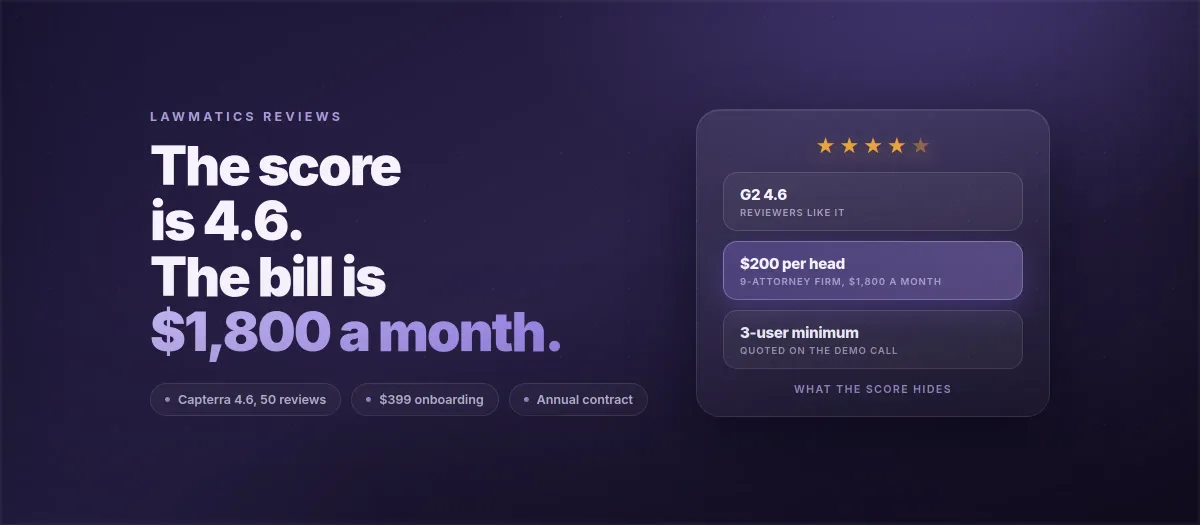
Quick answer: Reviewers agree that the Lawmatics automation engine and support team are strong and that setup is slow. They don't agree on whether the price is fair, partly because nobody outside a demo call knows the price: lawmatics.com/pricing shows three tiers, a three-user minimum, and no dollar figures as of 27 August 2026. Firms that have sat through the demo report roughly $99 to $199 per user per month, a $399 onboarding fee, and an annual contract. The one bill we've seen in full belongs to a nine-attorney firm paying about $1,800 a month, or $200 per head, next to a separate Clio subscription.
4.6
Capterra (50 reviews) and G2 rating
$200/head
a real 9-attorney firm's $1,800 monthly bill, divided by nine
3 users
minimum on Essential and Premium, 5 on Enterprise
We build software for law firms and maintain an open-source Lawmatics connector, so we read these reviews as part of the job and we've sat on calls with firms that pay for it. Every quote below is attributed and linked. G2 blocks automated fetches, so its 4.6 is the figure we recorded on 1 August 2026; everything else was pulled on 27 August.
What reviewers praise
The automation engine carries the product, and reviewers say so in nearly identical words across three sites. Lawyerist's review lists "Automations" first among its pros, followed by "Integrations" and "Marketing Tracking", and rates the product 4.5 out of 5. An immigration attorney on Capterra with more than two years on the platform writes that "the automations are great and give multiple options based on different entry conditions." A community reviewer on Lawyerist calls out "the endless possibilities with the customizable automations." In practice that means a lead from a web form or a phone call triggers the acknowledgment email, the text, the intake task, and the follow-up booking with nobody touching it. Clio Grow doesn't match that depth, which is why firms end up paying for two systems.
Support is the second consistent strength. Capterra's customer-service sub-score sits at 4.6, and a principal attorney there writes that "the support staff is incredible, and the Lawmatics University is a great resource." On Lawyerist, a reviewer six months in says "both their product and their customer service are amazing." Once setup is behind them, users call the day-to-day easy: a paralegal on Capterra says "I do love how easy it is to use once you've got the hang of it."
Reviewers don't mention the company behind the product, and buyers should know it. Lawmatics was founded in 2017 in San Diego by Matt Spiegel, who founded MyCase in 2009 and sold it to AppFolio in 2012. It has raised $12.5 million and ships steadily: time and billing, payments, a client portal, generative email drafting, and now a line of AI add-ons under the Merlin name. For an annual-contract product, a vendor that keeps shipping is a real strength. It's also why the CRM keeps creeping into practice-management territory.
What reviewers complain about
Setup time is the complaint that shows up in almost every negative line, and the sub-scores put a number on it. Capterra rates Lawmatics 4.2 for ease of use against 4.6 for customer service; that 0.4 gap is the setup story. An attorney six to twelve months in writes "it takes quite a bit of time to set up and fully customize." The paralegal who loves the product once you've got the hang of it says her only complaint is the difficulty of "setting up certain automations." Lawyerist condenses all of this into two words in its cons list: "Not Turn-key." Put next to the praise, the two sets of quotes describe the same product: automations worth having, which cost months of someone's attention to build.
Reporting is the second thread. A case manager on Capterra writes "can't create a report showing trust fund requests that are sent out." A COO on the same site notes "there is not test environment or blue/green production environment," which matters more than it sounds: every automation change goes live against real leads, with no sandbox to try it in first. More on the export and reporting limits in Lawmatics reporting: four ways to get your pipeline data out.
Price and contract terms are the third thread, and here reviewers are vaguer, which is itself the finding. Lawyerist lists "Expensive" as a con and describes pricing only as "custom pricing plans for law firms of all sizes so that you only pay for what you need." A Capterra reviewer says "the price could come down a bit" and lists e-signing and billing among the features he doesn't like. Nobody on any of the three sites says what they pay, which follows from the price never having been public.
The bill nobody publishes
As of 27 August 2026, lawmatics.com/pricing shows three plans, Essential, Premium, and Enterprise, with feature lists and no dollar amounts. Essential and Premium carry a three-user minimum; Enterprise carries five. The AI add-ons (Merlin Qualify, Merlin Engage, Merlin Copilot) and the Time & Billing add-on say "Contact Sales," and two of the Merlin products are described as "outcome-based pricing." The call to action on every tier is "Get a demo."
Our own Lawmatics cost breakdown from 8 August quoted two flat tiers, Lite at $199 and Pro at $299 a month, from the price list as it stood in June 2026. That page has since been replaced. The numbers were correct when checked and the line-item reconstruction still holds, but if you're comparing vendors today, the flat public tiers are gone.
From our research notes of 1 August 2026, compiled after a buyer call, firms report from the demo: roughly $99 to $199 per user per month by tier, Essential aimed at 3 to 10 attorneys, Premium at 10 to 30, Enterprise at 50 and up, a $399 onboarding fee, and an annual contract. Use them to sanity-check your own quote, in writing.
| A real 9-attorney firm, Oregon, 12 practice areas | Amount |
|---|---|
| Lawmatics, monthly | ~$1,800 |
| Per attorney, monthly ($1,800 ÷ 9) | $200 |
| Lawmatics, three years at today's rate, plus $399 onboarding | $65,199 |
| Clio Advanced, run alongside (our estimate from the call) | $2,000 to $3,000/mo |
| Combined stack, the firm's own yearly figure | ~$60,000 |
The firm is a nine-attorney general practice in Oregon that has run Clio Advanced, Lawmatics, and Claude together for about ten months. Divided by nine, their $1,800 lands inside the demo-call range, which is the closest thing to a public price check this product has. Three years at that rate is $64,800 before onboarding and before any renewal increase, with the practice-management subscription on top. The attorney who walked us through it asked, in these words: "can Clio and Lawmatics be combined into one product?" What the two-system stack duplicates, and when combining it justifies a migration, is the subject of Clio + Lawmatics: what the two-system stack really costs.
The API side
The review sites don't cover the API, and it decides whether the reporting complaints above have a workaround. Lawmatics publishes a REST API at docs.lawmatics.com, version 1.22 as of May 2026, with OAuth2 login, a forms API, and outbound webhooks for matter creation, status changes, form submissions, invoice payments, document signatures, and contact updates. The documented rate limit is 150 requests per minute per firm, three times Clio's 50. One page of the docs also cites 50, so our own connector throttles to the lower figure until Lawmatics confirms which applies.
Developer Settings is switched off on every account by default. A firm emails api@lawmatics.com or opens a support ticket to have it enabled; it's free, and it isn't self-serve. Once an OAuth app exists, the access token it issues never expires. There are no refresh tokens and no permission scopes, so any token is full read and write across the firm's data until someone deletes the developer app. For a CRM holding every prospective client's intake answers, that token needs a named owner, a password manager entry, and a written revocation step.
What the API supports: reports the native tool lacks (matters by source and practice area with custom intake fields, for instance), a webhook-driven nightly sync into a spreadsheet or warehouse, and a parallel-run migration if a firm ever consolidates two systems, since both Clio and Lawmatics expose enough surface to copy records while both stay live. What it doesn't: pipeline stages are read-only, so nothing outside Lawmatics can move a matter between stages; requests take one filter; pages are fixed at 25 records; invoices, pipelines, sources, and campaigns are read-only; e-signature, document templates, email sending, and automation management aren't reachable; and webhooks are configured only in the dashboard.
Our open-source Lawmatics connector for Claude sits on this API: 37 tools, MIT licensed, a read-only mode that removes every write tool, and a local audit log. Its README says it plainly and so will we: it was built against the official documentation with 80-plus unit tests and "has not yet been run against a live firm account." Custom-field writes are under-documented by Lawmatics, so that tool ships behind an experimental flag. The setup guide covers the support email and the one-time auth step; Lawmatics MCP vs Zapier lays out what each route can and can't touch.
Who Lawmatics fits
A consumer-facing practice with steady inbound volume, three or more seats, and one named person who will own the automations: personal injury, immigration, family, estate planning, criminal defense. The reviews above describe this firm, and for it the praise is earned. Budget the $399 onboarding, months of that person's time, and possibly a consultant. Check Lawyerist's "Lacks PI Integrations" con against your case-management system before signing.
A solo or two-person practice. The three-user minimum means paying for at least one empty seat, and the setup time falls on the lawyer. Clio Grow at per-user pricing, or a general CRM with a legal intake form on top, gets most of the benefit without the floor.
A firm already on Clio Manage with light marketing needs. Start with Clio Grow, which shares a contact record with Manage. Lawmatics earns its second subscription when the marketing automation is used every day; our two-system breakdown lists what the firms running both pay for twice.
A firm at eight or more attorneys already paying for Lawmatics and a practice-management system. This is the Oregon firm, and its question is the right one to price over three years. The rule we hold ourselves to on those calls: if the three-year math says keep both, keep both. Consolidation wins on rising seat counts, duplicated admin labor, and owning the workflow layer; until then, one combined view of both systems is available through their APIs without migrating anything.
A firm that wants software that works out of the box. Reviewers are unanimous that Lawmatics doesn't, and that's a question of fit.
FAQ
Is Lawmatics worth it?
For a firm with three or more seats, steady inbound consumer intake, and someone who will own the automations, reviewers on G2, Capterra, and Lawyerist say yes, and the 4.6 ratings back that up. Solo and two-person practices pay for empty seats under the three-user minimum, and firms that want software that works out of the box run into the setup complaints.
How much does Lawmatics cost per user?
Lawmatics doesn't publish per-user prices. As of 27 August 2026 the pricing page shows Essential, Premium, and Enterprise with a three-user minimum (five on Enterprise) and no dollar figures. Firms report roughly $99 to $199 per user per month from the demo, a $399 onboarding fee, and an annual contract. The nine-attorney firm above pays about $1,800 a month, or $200 per attorney.
What are the most common Lawmatics complaints?
Three threads repeat across Capterra and Lawyerist: automations take a long time to set up (Lawyerist's con is "Not Turn-key"), native reporting has gaps such as no trust-fund-request report and no test environment, and the price feels high for what a smaller firm uses. Support and the automation engine itself are rarely criticized.
Lawmatics vs Clio Grow: which one should a firm pick?
Clio Grow is priced per user, has no three-seat floor, and is the simpler choice for a firm already on Clio Manage with light marketing needs. Lawmatics wins when drip campaigns, round-robin booking, intake forms, and pipeline analytics are used every day, which is why many firms run both and pay twice for contacts, intake, and e-signature.
Does Lawmatics have an API?
Yes. Lawmatics publishes a REST API at docs.lawmatics.com (v1.22 as of May 2026) with OAuth2, webhooks for matters, forms, contacts, invoices, and signatures, and a documented limit of 150 requests per minute per firm. Access is off by default; a firm emails api@lawmatics.com to have Developer Settings enabled. Tokens never expire and there are no permission scopes, so any token has full read and write access until the developer app is deleted.
Sources: Capterra Lawmatics reviews (4.6, 50 reviews, fetched 27 August 2026); Lawyerist Lawmatics review (4.5 rating, fetched 27 August 2026); G2 Lawmatics listing (4.6 as recorded on 1 August 2026; G2 refused automated fetches on 27 August, so not re-verified); lawmatics.com/pricing (tiers and minimums, fetched 27 August 2026); docs.lawmatics.com (API v1.22); the README of our open-source Lawmatics connector; and a 2026 conversation with a nine-attorney firm in Oregon running Lawmatics alongside Clio (identifying details withheld). Demo-call pricing figures are from our own research notes, not confirmed by Lawmatics; prices change on the vendor's schedule.