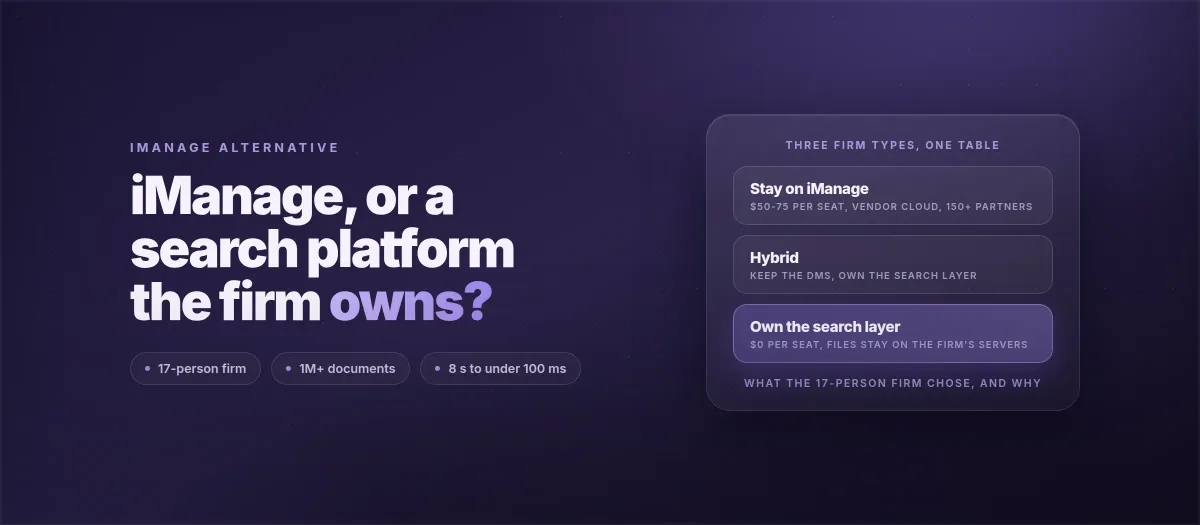
Quick answer: for a 17-person firm, iManage costs roughly $50 to $75 per user per month with a 10-user minimum, $10,000 to $30,000 to implement through a partner, and a specialised consultant after that; the firm reconstructed the three-year total at $85,000 to $255,000. The owned search platform cost approximately $40,000 to build, runs for $500 to $2,000 a month on the firm's own infrastructure, adds seats for $0, went live in 10 weeks, and returned searches under 100 milliseconds across more than a million documents and over $220,000 a year in recovered billable time. iManage is still the right buy for a firm that needs a full document management system or a vendor name its clients recognise. The owned platform is right for a firm whose problem is finding its own precedents fast and keeping them on its own hardware. Keeping the DMS and owning only the search layer is the third option.
We took the iManage side of that apart line by line in iManage pricing: the 3-year cost a 17-person firm reconstructed, including which figures are verified and which are the firm's allowances. This post is about the decision itself: what the firm would have got for the money, what it gave up by building, and which firms should make the opposite call.
$0/seat
employee 18, 30 and 50 cost the same to add, against $50-75 each per month
8 s → <100 ms
per search, across 1M+ documents, on the firm's own servers
10 weeks
design to live, 15 years of documents ingested, fixed price
What iManage does well
It's a document management system first and a search engine second, and on the first job it's very good. Matter-centric filing means every document, email and note lands in a workspace that matches how lawyers already think about their work. Email management from inside Outlook is the feature firms miss most when they leave. Version control, check-in and check-out, ethical walls between matters, records retention and the Office add-ins all come from more than twenty years of building for law firms specifically. iManage's own announcement of its April 2023 growth investment from Bain Capital Tech Opportunities put the customer base at more than 4,000 legal, accounting and financial services organisations in over 65 countries, which is why a lateral hire from a larger firm already knows how to use it on day one.
Two more things in its favour. The 150-plus implementation partners the firm counted are a cost, and they're also the reason there's somebody in almost every city who can install it and fix it. And larger clients' outside-counsel guidelines recognise the vendor by name, which for a firm doing work for banks or insurers can be the whole decision.
On search, we'll be fair as well. iManage Work has full-text search and for many firms it's adequate. The eight-second, phrase-only retrieval the firm complained about was the system it had before, and we don't know how iManage's search would have done on its million documents because the firm never got far enough to test it. What stopped the firm was the price, the consultant dependency and where the documents would live, in that order.
Where the bill and the lock-in bite
The per-seat line never ends. At $50 to $75 a month, every hire adds $600 to $900 a year for as long as the firm stays on the product, and a firm that shrinks below ten keeps paying for ten. The firm had the subscription at $30,600 to $45,900 over three years for 17 people, which on its own would have been tolerable. The rest of the bill moved the decision.
The consultant dependency doesn't show on a price list. Setup needed a specialised IT consultant, and the user reports the firm collected said most changes after go-live went back to that consultant too: a new workspace template, a sync problem, a permissions change. The firm had nobody in-house who could run an iManage environment, so each of those becomes a ticket with an invoice attached. That single line is why the firm's three-year ceiling reached $255,000 when the licence and the implementation together were under $76,000.
Migration runs in both directions and only one direction gets priced. Moving in was $15,000 to $30,000 through a partner. Moving out would be a second migration nobody quotes at signing, on the vendor's export terms, with version history and matter metadata that may or may not come along. The firm didn't get as far as asking. Any firm that does should get the export format in writing, whether history and metadata are included, and who runs it, because under the partner model that's a second engagement with a second fee.
Then there's what users report: a steep learning curve, limited customisation for the price, and software that occasionally crashes and, in the words the firm wrote down, "wipes documents". We can't confirm the crash reports independently and we won't inflate them. The one first-hand data point we hold, an associate at a larger firm who named iManage as the thing they'd most like to make disappear in our July 2026 questionnaire ("Having to save locally takes up so much space... creates memory problems"), is a single respondent and is offered as one voice.
Last, location. On the cloud product the firm's privileged documents would sit on a vendor's infrastructure. iManage does offer an on-premise deployment, which changes the location answer while leaving the licence, the partner and the consultant in place, so a firm that wants its files on its own hardware can get there with iManage too, at the same recurring cost.
What "owning the search layer" means in practice
The firm holds the code and runs the platform on servers it controls, in its own office or in a private cloud account it holds the keys to. The document store and the search index both sit on that hardware. Nobody outside the firm keeps a copy, and support can come from us or from any developer who can read a PHP application and an Elasticsearch index. The platform indexes documents where they already live, so the firm didn't have to move 15 years of files into a new system to search them, and it can sit over an existing DMS for a firm that has one.
This is the one place on our site where the sentence "documents never leave the firm's servers" is true without qualification, and it's worth being precise about why, because we've criticised that sentence elsewhere. When a hosted AI product reads a document, the text is sent to the vendor's model, and the defensible privacy claim there is about training and retention, never about location. On-premise search is different in kind: the index is computed on the firm's own hardware, a query travels from a browser on the firm's network to a server the firm owns and back, and no model vendor reads the text at any point, so there's no inference hop to disclose. The firm made that a hard requirement, and it holds on one condition it also insisted on: the semantic layer uses self-hosted embeddings rather than a hosted embeddings API. Choose the hosted API instead, which some firms reasonably do for quality, and the sentence stops being true; the accurate claim then becomes "not used for training and not retained", the same claim any hosted vendor makes.
Access control is scoped to matters. An associate sees the matters they're assigned to and nothing else, the groups come from the firm's directory over SSO with Active Directory or SAML, and permissions are applied to every search. Every query and every document opened goes to an audit log the firm reads in Kibana, which is what a client's security questionnaire is asking about when it asks who can reach privileged material. The mechanics are in permissions and audit trails for legal document search.
Ownership has costs of its own. Somebody has to patch the servers, run backups and renew certificates. Hosting runs $500 to $2,000 a month depending on where it lives and how much is indexed, there's a maintenance relationship with whoever supports it, and there's no vendor to call at 2 a.m. unless the firm has paid for one. And the platform does the search and knowledge job only: no Outlook filing, no versioning workflow, no ethical walls in the DMS sense, no Office add-ins. For a firm that had never bought a DMS and whose pain was retrieval, that was the right shape.
The numbers side by side
The iManage column is the firm's reconstruction, with the parts it could verify marked in the pricing post; the owned-platform column is what was delivered. Where the firm didn't measure something we say so rather than guess.
| iManage (reconstructed) | Owned platform (delivered) | |
|---|---|---|
| Per seat | $50-75 per user per month, 10-user minimum | $0 |
| One-time | $15,000-30,000 implementation partner (LexWorkplace lists $10,000-15,000 for 10-25 users) | About $40,000 build |
| Ongoing | Specialised consultant, storage, modules, support; no quote obtained | $500-2,000 a month hosting, plus maintenance |
| Three years, 17 users | $85,000-255,000 (firm's $5,000-15,000 per-user allowance) | About $58,000-112,000 ($40,000 plus 36 months of hosting) |
| Time to live | Set by the partner; the firm never got a date | 10 weeks, archive ingested |
| Search speed | Not measured by the firm | Under 100 ms on 1M+ documents, from 8 s on the old system |
| Research task, recovered time | Not measured or projected by the firm | About 20 minutes from 2-3 hours; $220,000+ a year at the firm's own rates |
| Where documents sit, who reads the text | Vendor cloud (on-premise option exists); vendor's search service | Firm's servers or private cloud it holds; firm's own index, self-hosted embeddings, no AI vendor |
| Access control and audit | Mature: ethical walls, matter security, audit | Matter-scoped roles from AD/SAML, every query and open logged |
| Email filing, versioning, Office add-ins | Yes, and this is the product | No |
| Who can change it | iManage, through a partner or consultant | Any developer the firm hires; the firm holds the code |
| Exit | Second migration on the vendor's export terms | Nothing to export; it's already on the firm's servers |
The rows where iManage wins are the ones an owned search platform doesn't attempt; the rows where the owned platform wins are cost, speed, location and control, and they're only worth winning if the firm's problem lives there.
Who should not do this
Stay on iManage, or buy it. If the DMS workflow is what you'd be paying for, an owned search layer solves the wrong problem. That covers firms whose lawyers live in Outlook filing, need version history and check-out on every draft, or run ethical walls the bar or a client requires; firms whose larger clients audit them against outside-counsel guidelines that name acceptable DMS platforms; and firms with nobody willing to own a server, because "the firm controls the hardware" is only a benefit when somebody in the firm wants to. It also covers small firms on arithmetic alone: at the 10-seat minimum, three years of iManage is roughly $18,000 to $27,000 in subscription plus $10,000 to $15,000 to implement, so a six-lawyer practice would pay roughly $28,000 to $42,000 against the $40,000 the 17-person firm paid for its build, with hosting on top. Below about 10 to 12 people the owned platform is the expensive option, and we'd say so on the call.
Hybrid: keep the DMS, own the search. A firm that already runs iManage or NetDocuments, is content with filing and versioning, and whose complaint is that it can't find anything across its precedents can keep the DMS as the system of record and put an owned search layer over it. The platform indexes the DMS content, applies the firm's matter permissions, and answers in milliseconds with the synonym handling a legal corpus needs. This costs both bills, and it's still the right answer for a firm of 30 or 50 people where ripping out the DMS would mean retraining everyone and a second migration. The public case study's FAQ addresses this directly.
Own the search layer. The 17-person firm's profile: 15 to 50 people, documents spread across network drives, email and an older system rather than a DMS the firm would be leaving, a knowledge-management role or an office manager who'll own the platform, and clients or a compliance posture where "on our servers, no vendor copy, no AI vendor reads it" is a requirement. If the daily complaint is that a research task takes hours and search returns the wrong documents slowly, and nobody is asking for Outlook filing, this is the group. Read the ownership-costs paragraph twice before signing anything.
A firm that wants an AI drafting assistant over its documents has a different problem with different vendors, and neither iManage nor an owned search platform is that product.
Not sure which of the three groups your firm is in?
Tell us your headcount, where your documents live today and what the daily complaint actually is, and we'll place you in one of the three on a 30-minute call. If the answer is iManage or NetDocuments, we'll say that. We built the platform in the LegalSearch case study and we know exactly where it stops.
Book a 30-minute call →Frequently asked questions
Is there a real alternative to iManage for a small law firm?
There are three, and they solve different problems. NetDocuments is the direct competitor, a cloud DMS with the same shape of per-user pricing and a partner channel. A Microsoft 365 and SharePoint setup with a legal add-on covers filing and versioning for firms already paying for 365. An owned search platform on the firm's own servers solves retrieval over existing documents at $0 per seat and does not do email filing, versioning or ethical walls. Name the problem first: if it is the DMS workflow, choose between iManage and NetDocuments; if it is finding your own precedents fast, an owned search layer is cheaper and stays on your hardware.
Does an owned search platform replace iManage entirely?
It replaced iManage as a purchase for the 17-person firm because the firm's problem was search and it had never bought a DMS. It does not replicate the document management functions: Outlook email filing, check-in and check-out, version history, ethical walls, records retention and Office add-ins are not part of the platform. A firm already on iManage that is happy with those and unhappy with retrieval can keep the DMS as the system of record and put an owned search layer over it, the hybrid option described in this post.
Do documents really never leave the firm's servers with an owned search platform?
Yes, on two conditions the 17-person firm insisted on. The platform runs on servers the firm controls, in its office or in a private cloud account it holds, so the document store and the search index sit on the firm's hardware and no vendor keeps a copy. And the semantic layer uses self-hosted embeddings, so no text is sent to a hosted AI model. Choose a hosted embeddings API instead and the sentence stops being true; the accurate claim becomes that the text is not used for training and not retained, which any hosted AI vendor can also say.
How long does it take to build an owned legal document search platform?
The 17-person firm's platform went live in 10 weeks from design to deployment, including 15 years of documents with OCR for scanned files. Eight to twelve weeks is the range we would plan for a firm of 15 to 50 people. What moves it is the number of document sources, how much of the archive is scanned, and how far matter permissions have to mirror an existing directory. Indexing runs in the background, so the firm starts using the platform before the full archive is in.