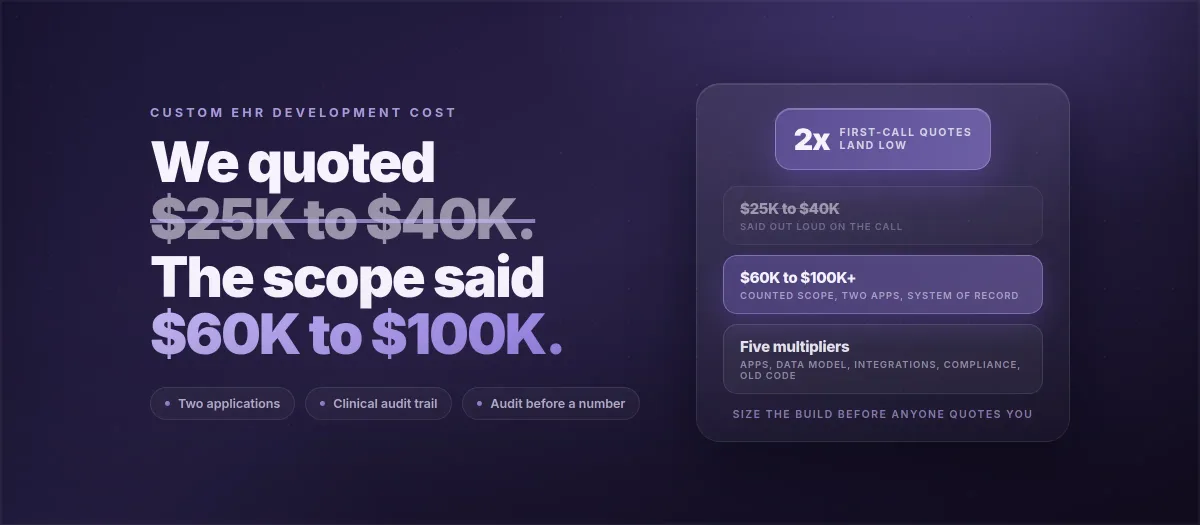
Quick answer. EHR quotes given before anyone has seen the scope tend to land low by about half, because the cost is driven by counts nobody has made yet: how many applications, how many roles, how many external systems, and whether the thing is a system of record. Five multipliers turn a $30K-sounding project into a $60K to $100K one: a second application, a clinical data model with a field-level audit trail, integrations (pharmacy, labs, billing), compliance as its own line, and a codebase that already exists and has to be read before it can be priced.
A portal on an existing EHR starts around $17K, a focused single-workflow EHR around $26K, and a two-app EHR that's the system of record for a facility around $60K, with the top of the band set by your scope.
The call where we got it wrong
He found us through AI search. Claude and ChatGPT had both named us when he asked for a healthcare development shop that takes compliance seriously, and our analytics show what he did next: landed on the homepage, went straight to pricing, spent a minute on the team section and clicked through to a LinkedIn profile, read the case studies, and clicked "book a call" 4 minutes 27 seconds after arriving. He went back to pricing once more to double-check and confirmed the booking at 5 minutes 43 seconds. The order was price, then people, then proof, then the booking. He'd come from growth equity and evaluated us the way he'd evaluate a deal.
On the call there were two of us and one of him; his co-founder, a psychiatrist, wasn't there. The company was pre-revenue and bootstrapped, he was going full-time the following week, and both his grandparents had died of dementia. The product was a system of record for memory-care facilities: a mobile app for caregivers on the floor and a browser app for the care coordinator who runs the building. Angular on the front, .NET on the back, PostgreSQL, Azure. Two senior developers with twenty-plus years each had already put in 15 to 20 hours a week for three months. There were 40 to 50 hours of wireframes, product requirement documents, staging environments for both apps, and an Azure DevOps repo he offered to open to us on the spot.
Then he asked what it would cost, and we said $25K to $40K. One of us added "if it's simpler we can go lower." He didn't flinch, and that should have told us something. So should the line he'd said a few minutes earlier: American agencies were "so salesy", they "mark up offshore labor 150%", he'd rather work with us. He already had a number in his head, and we'd just handed him one well under it.
After the call we wrote the scope down properly. Two front ends. A shared API. A clinical data model where every note, medication event and incident has to carry who, when and what changed. HIPAA controls and a business associate agreement on Azure. Staging and production environments for two applications. An audit of three months of somebody else's code before any of that could be estimated. AI and voice features parked for a later version. The $25K to $40K we'd said out loud covered roughly one of the two applications. The honest band was $60K to $100K, with the plus sign carrying the codebase question.
What made it worse was that we weren't even consistent with ourselves. Our internal brief for healthcare work said builds land at $15K to $40K. A market analysis we'd written two months earlier said $30K to $90K. The call said $25K to $40K against a real $60K to $100K and more. Three numbers in our own files, none of them derived from a counted scope. That's the state most agencies are in when they answer your pricing question in the first twenty minutes, and it's why the answer is usually low.
Where the public numbers come from
ScienceSoft's EHR development page says custom EHR development "can range from $120,000 to over $2,000,000" and puts a first release with priority features at 2 to 4 months. Thinkitive's cost guide, updated July 2026, says "most custom EHR development projects cost between $50,000 and $500,000+", with MVPs starting at $50K to $100K. Our own custom EHR development page says a focused EHR starts from $26K and a multi-role one from $44K. None of these are lying. They're describing different objects, and the price of yours depends on five things the first call never counts.
The five multipliers
1. Two applications, not one
A caregiver app and a coordinator app share a database and an API, and people assume the second one is cheap because "the backend is done." The caregiver app runs on a phone, on facility wifi that drops in the back corridor, in the hands of someone with a resident in front of them; it needs offline capture, sync, a fast medication-pass flow and big buttons. The coordinator app runs on a laptop and needs schedules, staff management, incident review, reports and exports. Different screens, different roles, different testing, and a decision about progressive web app versus native that nobody had made yet. In our scoping a second application on a shared backend adds 60 to 80 percent of the first one's cost. A two-app product quoted at a one-app price is a quote for one app.
2. The clinical data model and the audit trail
A portal reads and writes a few things against a record that lives somewhere else. An EHR is the record, and that changes the shape of the whole database. Every vitals reading, medication administration, care note and incident needs who entered it, when, from which device, and what it looked like before it was changed. Nothing gets deleted; things get superseded. Roles have to be enforced down to the field, because a night aide, a nurse and a family member see different slices of the same resident. That's a few weeks of design and a permanent tax on every feature afterwards, since each new screen has to respect it. It's the multiplier first-call quotes skip most often, because it's invisible in a demo.
3. Integrations: pharmacy, labs, billing
A facility's EHR eventually has to talk to a pharmacy for medication orders and the eMAR, to a lab for results, and to whoever does billing. Each of those is its own small project: credentials and a sandbox that doesn't behave like production, a data mapping, failure handling for when the other side is down, and a test plan that involves another company's support desk. We already publish $5K to $15K per external system for FHIR-based work, and legacy HL7v2 sits at the top of that band. Three integrations is $15K to $45K on top of the build. A first version often needs zero integrations and a data model that's ready for them, written into the scope so nobody's surprised in month four.
4. Compliance as a line item
HIPAA work on a build like this is a block of effort that doesn't scale much with app size: the business associate agreement with Azure and the configuration it requires, encryption at rest and in transit, access logging, session and device rules for shared phones on a care floor, a written risk assessment, a breach procedure, and the evidence file you'll need when a facility's compliance officer asks. On our statements of work it's a named line with its own price. Three delivered platforms of ours have been through HIPAA audits, including a HIPAA case-management platform for a structured-settlement firm, and the evidence file is what the auditor reads first. A quote with no compliance line is either doing that work for free, which is unlikely, or not doing it, which is what we find in rescues. If the answer is "it's included", ask what the included part contains.
5. The codebase you inherit
Three months of two senior developers at 15 to 20 hours a week is somewhere between 360 and 480 hours of work sitting in a repository. Nobody knows whether that's an asset or a liability until someone reads it. It might be a solid .NET backend that saves weeks, or a backend with no audit trail and patient data in the logs, which costs more to fix than to replace. A DEA-compliance platform we rescued in eight weeks came to us as a broken build, and we couldn't have put eight weeks on it without reading it first. On the call we said the right thing, "we'll audit it, then decide whether to extend or rebuild", and then contradicted it by giving a number anyway.
A sizing worksheet
Count, then read the row. The "from" figures match our service page; the top of each band is whatever your scope adds up to, which is why there's no ceiling column.
| Signals | What you're building | Where the number lands |
|---|---|---|
| One app, reads and writes against an EHR that already exists, patients and families as users | Patient portal | $17K to $44K, 4 to 8 weeks |
| One app, one specialty workflow, up to three roles, no external systems | Focused EHR | From $26K, 6 to 8 weeks |
| One app, several roles, clinical notes, documents, billing exports, audit trails | Multi-role EHR | From $44K, 8 to 10 weeks |
| Two apps (floor staff mobile plus coordinator web) on a shared API, offline capture, field-level audit | Two-app EHR, system of record | From $60K, 8 to 12 weeks, top end set by the rows below |
| Each pharmacy, lab or billing connection | Integration | Add $5K to $15K each |
| A codebase someone already built | Unknown until read | Paid audit first ($2,420, credited to the build), then extend or rebuild |
| AI summaries, voice notes, predictions | Version two | Scope separately, after the record exists |
The dementia-care project read like this: row four, plus row six, plus row seven deferred, plus zero integrations in version one. That's a "from $60K" project before anyone opens the repo, and we said $25K to $40K. If the quote you've been given sits under the "from" figure for your row, you've been quoted a different row. The same counting works on the $35K versus $200K MVP question and in our MVP development cost guide; an EHR just has more rows that can't be skipped.
What we do differently now
We don't put a number on a project with an existing codebase until we've read the codebase. The sentence we use is the one we should have used in April: "We'll have a real number after we've reviewed your code and scoped it properly. I'd rather give you an accurate number than a guess." For a greenfield build the first call is free and ends with a draft scope and a rough range. For anything with prior work the next step is a paid audit at $2,420, three to five days, credited toward the build if you go ahead, findings yours if you don't. The number that comes out of it is fixed.
We also ask your range before we give ours. He asked first and we answered first, and that cost us the anchor. Nobody on our side says "if it's simpler we can go lower" any more, because nothing with two apps and a clinical record turns out simpler.
On price we'll say what we say everywhere. Our builds start from $12K for the smallest scoped pieces, a focused EHR from $26K, a multi-role one from $44K, and there's no published ceiling because the ceiling is what your scope adds up to. Fixed price once scoped, milestones written down, eight weeks of support after launch included.
When an EHR should not be custom
If you run skilled nursing, MDS reporting alone is a reason to buy a certified product; assisted living and memory care don't carry that requirement, which is why custom is even on the table for them. If a standard workflow covers 80 percent of what your staff do and the vendor's mobile app is tolerable, buy it and spend the money on a portal or an integration. If you need to be live in six weeks, buy; a two-app EHR doesn't ship in six weeks from anyone who's counting honestly. If there's no clinician on your side to own the data model decisions, you'll get an engineer's guess at how care works, which is expensive to unwind. And if the honest band is $60K and the budget is $30K, half an EHR is worse than a whole portal on top of someone else's EHR. Custom makes sense when the workflow is specific to you, the user count is small enough that per-seat licensing would cost more than the build, or you need an integration the incumbents won't do. That was true for the dementia-care founder and it isn't true for every facility.
Want the number sized before you hear it?
Bring the app count, the role list, the external systems, and whatever code exists. New build: a draft scope and a range on a 30-minute call. Existing codebase: we'll tell you what the audit covers and what it costs, and the number at the end of it is fixed.
Book a 30-minute scoping call →Frequently asked questions
How much does it cost to build an EHR?
It depends on which object you're building. A patient portal on top of an EHR that already exists runs $17K to $44K. A focused custom EHR covering one specialty workflow starts from $26K over 6 to 8 weeks. A multi-role EHR with clinical notes, documents, billing exports and audit trails starts from $44K over 8 to 10 weeks. A two-application EHR that's the system of record for a facility (a staff mobile app plus a coordinator web app on a shared API) starts around $60K, and the top of that band is set by integrations, compliance scope and any codebase you bring, so we don't publish a ceiling. Large vendors publish $120K to over $2M for enterprise scope.
Why do EHR development quotes differ so much?
Because they price different things. Public ranges run from $26K to over $2M, and every figure in that span describes a different object: a portal, a single-workflow EHR, a multi-role EHR, a two-app system of record, or an enterprise platform with a dozen integrations. A quote given on a first call, before anyone has counted applications, roles, external systems and existing code, is usually low by about half. Ours was: $25K to $40K said out loud for a scope that added up to $60K to $100K and more.
What does a senior care or dementia care EHR cost?
For assisted living and memory care, the shape that keeps coming up is two applications: a mobile app for caregivers on the floor with offline capture and a fast medication-pass flow, and a browser app for the care coordinator with schedules, incidents, reports and exports, both on a shared API with a field-level audit trail. Counted honestly that's $60K to $100K and up before pharmacy, lab or billing integrations at $5K to $15K each. Skilled nursing adds MDS reporting, which is usually a reason to buy a certified product instead of building.
Should I ask for a price on the first call?
For a greenfield build with a counted scope, a rough range on the first call is reasonable and a starting figure should be stated plainly. If you already have code, no. Three months of two senior developers is 360 to 480 hours sitting in a repository, and nobody can price extending it versus replacing it without reading it. We now do a paid audit ($2,420, three to five days, credited toward the build, findings are yours either way) before any number on an inherited codebase.
How much of an EHR build is compliance work?
HIPAA work on a build is a block of effort that doesn't scale much with app size: the business associate agreement with the cloud provider and the configuration it requires, encryption at rest and in transit, access logging, session and device rules for shared phones on a care floor, a written risk assessment, a breach procedure and the evidence file a facility compliance officer will ask for. On our statements of work it's a named line with its own price. A quote with no compliance line is either doing that work for free or not doing it.